The Learning Curve: Teachers Union Elections Heat Up
 EM - News Moderator


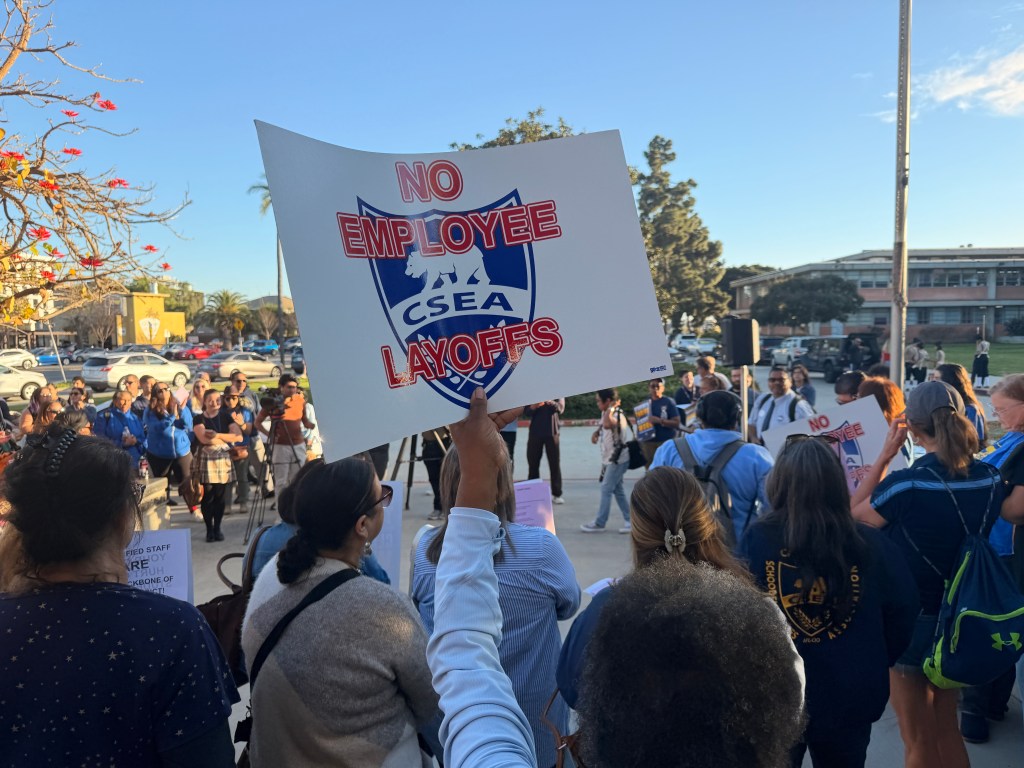
On Tuesday afternoon, a couple dozen people wearing blue shirts rallied outside of San Diego Unified’s central office. They were classified employees, people employed by the district who aren’t certificated teachers – family services assistants, front desk staff, ESL aides, health technicians – and their jobs were on the chopping block.
As the district faced down another big budget deficit, a projected $49 million shortfall, officials were proposing cutting 221 positions. Roughly 90 of those were filled. The rest were vacant.
To classified staff, the cuts had a dash of cruel irony. Not only they the least-paid district employees, district negotiators recently reached a deal with the teachers union that guaranteed raises and promised to spare them from layoffs.
“Everything is falling on the backs of classified staff and we’re the lowest paid employees they have,” said Megan Glynn, the first vice president of the local chapter of the Office-Technical and Business Services union. “This is absolutely telling you who the district respects and values, and it sure isn’t us.”
Even the turnout, which was much lower than a flashy rally held by the teachers union last month, is evidence of the power imbalance. Classified staff were only notified of the planned vote on Friday, when the board’s agenda was published. The rally took place when many employees were busy working the second or third jobs they need to keep to get by, said one speaker.
Glynn, who works as an administrative aid in special education services, said these cuts are just the latest in a longer trend. Last year, her union lost 100 people. Her department alone has been whittled down from seven people to two since she was hired. That night, officials wanted to cut her last remaining colleague, leaving only her to coordinate the needs of the district’s special educators.
“Continuing to absorb additional work without additional people is just not possible. People are quitting. People are going out on stress leave,” Glynn said. “What it’s going to lead to is worse outcomes for students. They’re going to suffer.”
Union Election Gets Testy
For members of the newly formed Good Trouble caucus, a group of educators running for leadership positions in the San Diego Education Association, the layoffs are indicative of a broader problem – a lack of transparency that’s brewed dysfunction. Caucus members largely blame Kyle Weinberg, the union’s president, for the dysfunction.
They point to the fact that no one in the union’s current leadership is running as part of Weinberg’s slate of candidates. His Vice President, Monique Barrett, is even running to replace him as president, as part of the Good Trouble caucus.
Matthew Schneck, an East Village Middle College High School teacher, is running for union vice president as part of the Good Trouble caucus. Schneck said the classified layoff announcement blindsided teachers, too.
But that wasn’t the worst surprise, Scheck said. He also learned that other district unions had fallen out with Weinberg.
“It wasn’t until a couple months ago that the board learned that the relationship between Kyle [Weinberg] and our sibling unions had gotten so bad that they weren’t even talking to us,” Schneck said. “Had we known that, could we have been negotiating together with [the classified union]?”
(Weinberg said SDEA leadership have long worked with their sibling unions to advocate for shared goals and will continue to do so.)
A joint negotiation could have yielded some benefits for classified staff. The district’s teachers union, and its connection to its statewide parent union, holds more political sway than any of the others.
Andrea Padilla, an SCPA teacher who’s running for the union’s board as part of the rebel caucus, said the teacher raises may be partially responsible for the classified cuts.
“At [a meeting of union representatives] last week, I stood up and I said, ‘I’m not trying to denigrate anybody’s work on the bargaining team, but you need to understand we’re going to lose over 200 classified employees because of our raise. Would you guys rather take a raise, or would you rather keep our para educators and our secretaries and our lunch folks.’ Most of the people there said we would want to keep our people,” Padilla said.
Weinberg’s ‘People Power’ Caucus
Weinberg, who’s running for a third term as president on his People Power caucus, sidestepped the pointed personal criticisms. He instead focused on the wins he said the union had racked up during his tenure, from advancing affordable workforce housing to building the district’s community schools programs to securing raise after raise and gold-standard health benefits.
But he doesn’t deny that the union has room to improve. He said there are efforts underway to increase transparency, communication and members’ abilities to advocate for priorities.
Weinberg, who was also at the district’s central office for yesterday’s board meeting, was similarly opposed to the layoffs of the classified staff. He said that he didn’t believe they were needed to balance the district’s budget.
“We’re going to continue to stand alongside our classified siblings and oppose these layoffs because they heavily impact our students,” Weinberg said. “We believe the district is attempting to pit the classified employees against the certificated employees.”
Even given the discord, Weinberg said he views the crowded field as a good thing for the union’s democracy. And it is a crowded field. Alongside the Good Trouble caucus, current union Treasurer Lisa Morris is leading her own caucus.
“That gives members lots of options, so they have people who can represent their values and their vision,” Weinberg said.
Elections for SDEA leadership begin next week.
About the Layoffs
Despite SDEA members’ joint opposition to the classified layoffs, it ended up being too late. During the meeting, San Diego Unified’s board voted unanimously to approve the preliminary layoff notices.
The decision isn’t necessarily final. Over the coming months, district staff will continue to search for ways to close the budget gap and, ideally, minimize the current projected layoffs, officials said.
“What I’m still hoping for … is that we’re able to actually come to a win-win, where there’s positions and availability and maybe even promotions for folks that are impacted,” Superintendent Fabiola Bagula said.
The Acorn Awards Are Here!
Surprise! Voice of San Diego launched an education awards program!
The awards use our homespun income vs. test score metric, developed in partnership with data gurus at UCSD, to identify schools really moving the needle for students. The metric controls test scores for the percentage of low-income families at a school, offering a more nuanced peek into student achievement.
All this week, we’ve been rolling out pieces about the schools that have won our inaugural Acorn Awards. Tomorrow, the final handful of pieces will be published, but here’s a sneak preview of the schools taking home the top prizes.
- The top performing San Diego County elementary school: San Onofre Elementary School
- The top performing San Diego County middle school: College Preparatory Middle.
- The top performing San Diego County high school: Helix High.
- The top performing San Diego County school of all 700-plus included in our analysis: Helix High.
- The ‘Growing Strong’ award, given to the San Diego County school that’s improved the most since 2021: Mission Bay High.
- The ‘Dedicated District’ award, given to the top performing school district in San Diego County: Fallbrook Union Elementary.
- The ‘Staying the Course’ award, given to the San Diego County school with the highest average score on our metric since 2021: Helix High.
- The ‘Success For All’ award, given to the best performing San Diego County school with a disproportionate percentage of English language learners: Edison Elementary.
The post The Learning Curve: Teachers Union Elections Heat Up appeared first on Voice of San Diego.