The Learning Curve: San Diego Unified Board Candidates Run Unopposed
 EM - News Moderator



Last month, I wrote a newsletter about the campaign launch of Hayden Gore, a school board candidate running to replace San Diego Unified Trustee Cody Petterson in coastal District C.
Gore, a classroom educator who helped unionize the High Tech High charter chain, is a dreamy candidate for the school board kingmaker – the San Diego Education Association, the union that represents San Diego Unified teachers. That’s why the union wasted no time in endorsing him. Those early endorsements can have the power to scare away other interested parties, I wrote.
We gave it the headline “A School Board Race Just Started – and Maybe Ended.” What a prediction.
The candidate filing deadline came and went for this year’s primary election, and Gore ended up being the only candidate who qualified.
That wasn’t all, though. Shana Hazan, who represents District B, is also the only candidate who qualified in her race. That means the district won’t even bother with a primary, thanks to a charter amendment voters approved a couple of years ago. Hazan and Gore will be the only candidates on your ballot in November, which means, barring any wild write-in campaigns, they’re a lock to win.
That lonely status likely came as a bit of a relief to Hazan – and to some of her supporters at the teachers union. That’s because she hadn’t quite earned the union’s endorsement. Though Hazan is, by all accounts a competent campaigner, the union’s endorsement is the single most important nod in school board races.
The union had initially planned to give her what’s called a friendly endorsement, a process by which it approves an endorsement for a candidate it has previously endorsed, without having them jump through the hoops set up for first-time candidates. Unluckily for Hazan, the vote on that friendly endorsement came shortly after the board’s unanimous vote to eliminate hundreds of classified positions.
Between Hazan’s ‘aye’ vote on the layoffs and existing turmoil within the union about how the layoffs came to be, her friendly endorsement was voted down resoundingly.
It’s not over, though. Kyle Weinberg, the union’s president, said SDEA’s endorsement panel would be scheduling an interview with Hazan, and a subsequent vote on her endorsement in the coming weeks.
“We did endorse Shana in 2022 because she is an ally to union educators and she has demonstrated that during her time on the board over the last four years,” Weinberg said. “It’s not easy to be a school board member. We need school board members who are dedicated to advancing the best interests of our students and our schools and we’ve had that with Shana.”
Union Turmoil: Ballot Wars Edition
If you read my piece from yesterday, you know that SDEA has been facing some serious internal turmoil. That turmoil has been building for months, with divides between the district’s teachers union and the unions that represent other staff widening.
It’s gotten so bad that the heads of some of the district’s unions told me Weinberg, the SDEA president, had actively harmed their members. Frustration with Weinberg, and the strained relationship with SDEA’s sibling unions, is part of what inspired a group of district staff to run a slate challenging him during the union’s ongoing leadership race. Now, some members of that group, who call themselves the Good Trouble caucus, are raising concerns about the election process.
Take Juan “Wicho” Flores, a counselor at Logan Memorial Educational Campus and longtime community fixture.
Elected union leadership is split into both officer positions – think president and treasurer – and board members, who represent various clusters of schools and grade levels.
Flores filed to run for seat 5, which represents educators at secondary schools in the Lincoln, Logan Memorial, Mission Bay and San Diego clusters. Then, after filing to run, he delivered a campaign speech at the union’s headquarters. It wasn’t until days after members’ electronic ballots were emailed to them that he heard from a friend he was no longer listed as a candidate. He checked and, sure enough, he wasn’t listed.
So, he got in touch with the union. They told him that because he was a counselor, he could only run for an at-large seat on the board, not a secondary or elementary seat. They also told him that according to their records, Logan Memorial – where he works – was listed as an elementary school.
That was a problem, because Flores had filed to run to represent secondary schools that include Logan Memorial.
Flores said that, essentially, union officials were disqualifying him twice. First, he should have run for an at-large seat. But second, Logan Memorial isn’t a secondary school, they claimed. (Logan Memorial is currently a K-12 school.)
A couple of days later, the union put Flores back on the ballot, but he remains unsure what all of this means for his candidacy. Even now, none of his coworkers at Logan Memorial are able to vote for him. He can’t even vote for himself.
“My question to them was, ‘if I did something wrong, when I submitted the paperwork, why didn’t you guys bring that to my attention? And when I came and did my speech, why didn’t you guys bring it to my attention then?” Flores said. “If things like that happen for one person, it makes the entirety of the election process questionable, at least from my point of view.”
Keashonna Christopher, another longtime counselor at the district and member of the Good Trouble caucus, has experienced similar election peculiarities. She said the ballots received by some district staff, including her own ballot, are for voting areas where they no longer work. Since members can only vote for candidates running in their area, that means that while some staff at her current site can vote for her, Christopher, like Flores, is unable to vote for herself.
But this isn’t the only election Christopher has raised concerns over. In 2024, Christopher submitted her name to run for the association representative for counselors. When the election came, though, she said her name was excluded.
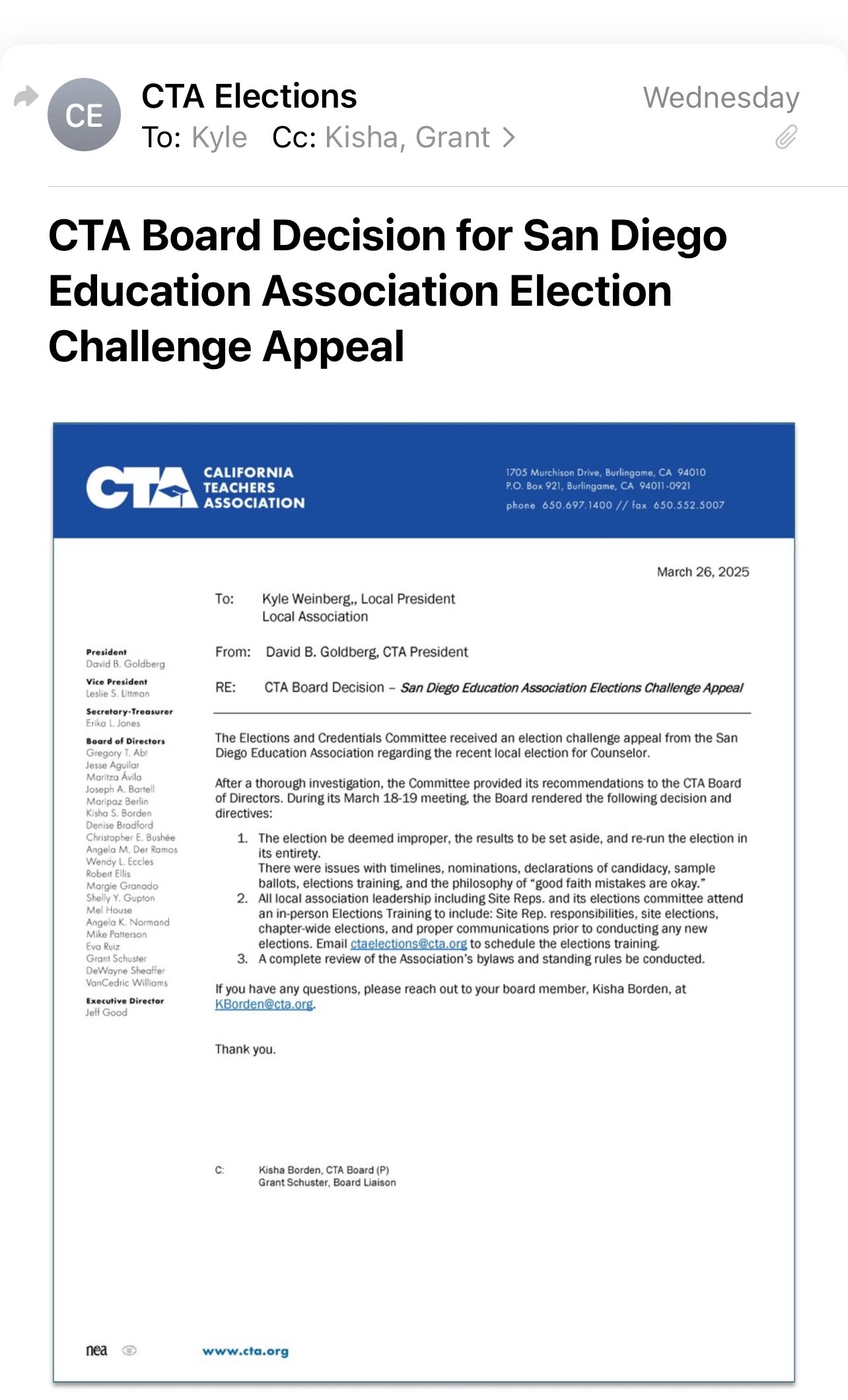
Christopher said she submitted a challenge to the election to SDEA, which did not go anywhere. So, she submitted an election challenge appeal to the California Teachers Association, the statewide union to which SDEA belongs.
The CTA ultimately sided with Christopher, writing in a March 2025 decision that the “election was deemed improper.” They advised SDEA to disregard the results, schedule a re-do and set up election trainings for those involved. Christopher won that re-do.
Now, she’s worried the union didn’t learn its lesson.
“Some of us have lost faith in the democratic process. We’re not honoring democracy if we’re not running good elections,” Christopher said. “I’m willing to challenge again, if need be.”
Weinberg said the details of SDEA’s elections are managed by the elections committee.
“As far as I know the SDEA elections are being run according to our SDEA governance documents and the requirements of our state union,” he said.
The union’s two votes – for leadership and on its controversial new contract that some have tied to the layoffs of their colleagues – began last week and end on Friday. Weinberg said early results for the leadership election will be available Friday. If no candidate receives 50 percent of the vote, a runoff will be scheduled for next month.
Catch SDUSD Superintendent at Upcoming Voice Event
San Diego Unified Superintendent Fabiola is taking part in a panel conversation hosted by Voice of San Diego next week! The event is called Women Leading the Conversation and will explore how our panel of leaders is tackling the task of Building the Finest City.
Get your tickets now – last year sold out. They’ll only run you $65. The event takes place on March 26, from 5:30 to 8:30 pm
The post The Learning Curve: San Diego Unified Board Candidates Run Unopposed appeared first on Voice of San Diego.