She was Dolores Huerta’s strategist, then her friend. Now she calls César Chávez a monster
 Dante Ulanday - News Moderator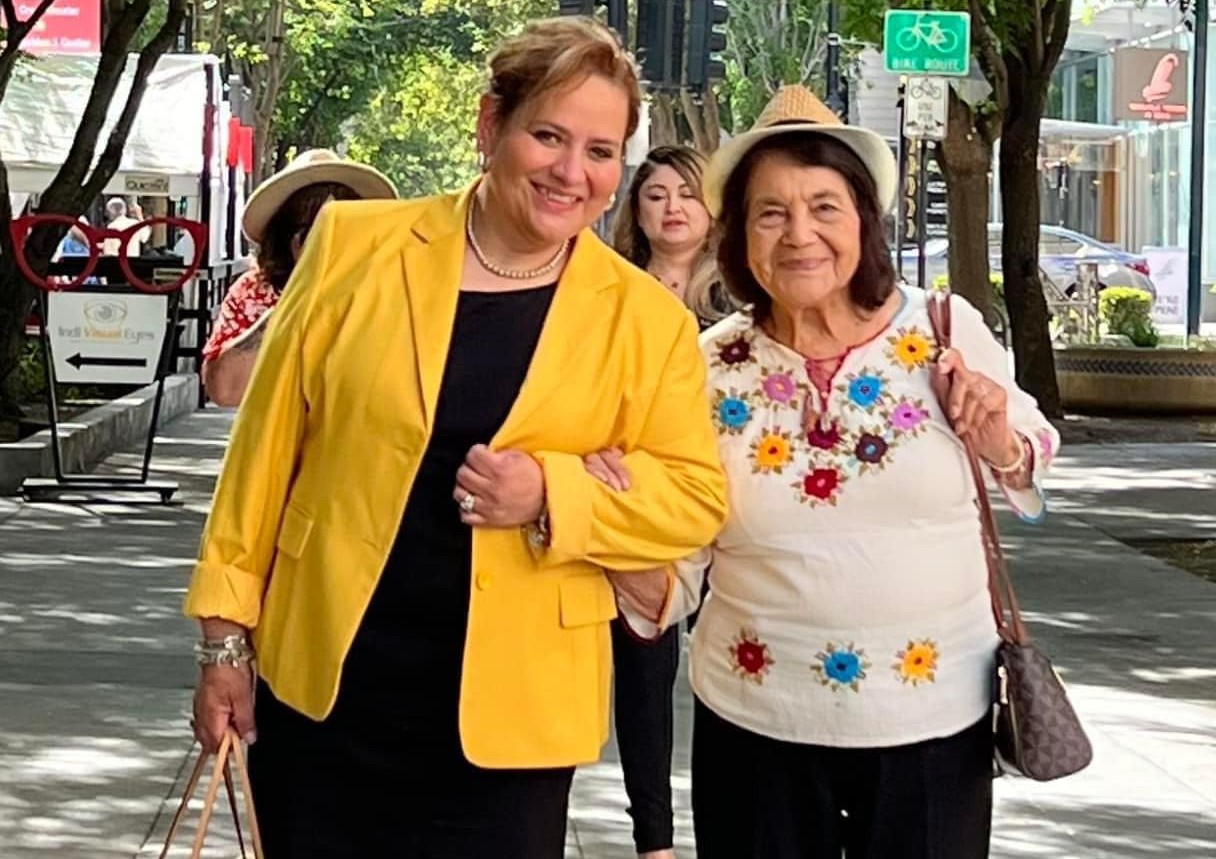



This story is also available in Spanish here.
For 11 years, Patricia Portillo worked as a communications strategist for Dolores Huerta — a role that allowed her to build a close personal bond with the farmworker leader. That relationship took on new weight after Huerta revealed in a New York Times article that she had been sexually abused by César Chávez while both were leading the farmworker movement in the 1960s.
We spoke with Patricia Portillo to hear her reaction, given her long relationship with the 96‑year‑old activist, with whom she last spoke just two weeks ago.
What was your reaction when you heard about Dolores Huerta’s allegations?
This morning, I was still half-asleep, and I saw the article, and I jumped up, almost
vomiting. Of course. The stomach pain — like someone punched me in the gut. Like I wrote on Facebook, I feel like my heart is split in two, Ale. Actually, I feel like my heart is shattered into pieces. I feel nauseous, disgusted — truly disgusted. I worked for 11 years with Ms. Dolores. I recruited her into an organization where I worked for over a decade. I was her strategist — if that’s the right word — her communications strategist for 11 years. I recruited her, wrote her op-eds, lobbied with her, traveled with her, drove my car with her in it. And she always told me, “Always fight. Don’t let anyone walk over you, no matter who it is.”
How did you feel?
So for me, this was really … She helped us pass eight laws, including one that had been impossible to pass for 30 years. That’s how powerful she is. And today, Ale, today feels like a very, very sad day for our community. First of all, for Ms. Dolores, and for those young girls who are now coming forward. Just thinking that Dolores fought so hard, for so long … And now I understand why she always fought so fiercely for women. Now I understand. I
mean, I know why we fight, but she always said, “Don’t let anyone walk over you, Patricia. Never let anyone walk over you.”
And without knowing that … I can’t imagine what Ms. Dolores has been going through.
The strength she has carried for so many years, without anyone knowing she was
carrying such deep pain in her heart. And now, as she’s about to turn 96, but it’s never too late. And Dolores has shown us that. Did you ever imagine something like this? Never, never. Because of the strength she always showed. And I can say she’s my role model, truly.
What does Dolores Huerta represent to the Latino community?
I’ve known her since I was a reporter. She even introduces me as her reporter. I was in Houston with her — I took her out to eat in Houston, I took her to the Museum of
Tolerance in Houston, where she’s actually featured. I walked in with her, (4:06) and there was a display — yes, they were showing her in the museum. I walked in, paid my ticket — I don’t remember, maybe five dollars — and she had already gone inside but had stepped out to the restroom. When they saw I was with her, they said, “Are you with Ms. Huerta?” I said, “Yes.” They refunded my money.
And when I saw her at that event, she walked in and said, “I’m with Patricia.” “I’m with Patricia.”
That’s the humility she has. But she also has incredible strength. She did a full interview. And she did it again. The part I liked — I told her, “Please, do it in English.”
Did you ever imagine that something like this could happen to a woman like her, with so much influence and power?
Why do they wait so many years? It’s unacceptable. It’s incomprehensible to see the deep harm done to a woman — or a man — when someone acts against their will. And we’re seeing it with this person who is a woman of steel, but even she was hurt so deeply that she could never speak about it. The New York Times article says she only recently told her children. (6:30) I think what’s happening is extremely important, because I can imagine what Dolores Huerta must have gone through in deciding to take this step — knowing that one of the most important symbols of the Latino movement in the U.S. would fall.
Was she always in the shadow of Cesar Chavez?
And let me tell you something — this is something I’ve talked to her about. She is the author of
“Sí se puede,” but he — César Chávez — got the credit. When President Obama said, “Yes, we can,” it was because of her. So if Dolores is the icon she is today, if she is the woman we love and respect so much, imagine, Ale — at almost 96 years old — she is now an example that it’s never too late. We saw it with (Jeffrey) Epstein, with all those women coming forward in the “Me Too” movement. People always said, “Why did they wait so long?” But rape is rape. It’s against your will, and they take advantage of you. Dolores is a woman who’s maybe 4’11.” And the person who did this — someone who supposedly had moral stature. He is — well, I won’t say “is” — but he has been considered the hero of the Latino community. But for me, it was always Dolores.
That’s why I went to her. That’s why so much of what I do, I think of her. Sometimes I even talk
to her in my head: “Ms. Dolores, what do I do?” And she always says, “Patricia, don’t let anyone walk over you. No matter who it is.” Without knowing she herself had been a victim.
Have you been in touch since the article came out?
I texted her this morning. “I just read it. I have so much respect for you. A big hug,
Patricia.” And I also texted her daughter: “Alicia, good morning. I just read it. I’m so sorry. I have so much respect for your mother. A strong hug and solidarity.”

Had you spoken with Dolores recently before today?
I spoke with her two weeks ago. Because I’m in transition right now — changing jobs. I called her and asked, “What do you think, Ms. Huerta? What do you think about this?” “Yes, Patricia, this is your organization. This is the one that needs your voice. This is perfect for
you.” And that’s what I’m trying to find — an organization where I can be that voice.
I don’t know yet, but I hope to know soon. And I always say I’m her student. I’m a student of Dolores. Eleven years, day after day. Once I took her to Nevada. We were in my car, with her daughter too. I thought she was going to take a flight — but no, she came with me. And I’m terrified of mountains. And I had Dolores Huerta — an icon—in my car, and I was driving through mountains terrified. I thought, “My God, I have a national treasure in my car.” And she laughed. She said, “Patricia, nothing’s going to happen.” And then I’d see billboards saying “Sí se puede — Dolores Huerta,” and I had that icon sitting in my car. I was shaking — just like I was shaking today when I wrote what I posted on social media.
How do you see César Chávez now? What effect has this revelation had on you?
Honestly, it was never him. It was always her. I’ve known her since I was a reporter, since I
worked at La Opinión in 1998. And it hurts. Today is a very painful day for our Latino community. And today is a day of change. Because just like they took down statues of Confederate figures across the country, now we must do the same. Not us personally — I’m not going to go break anything — but today is the day that this icon, César Chávez, falls.
I remember when I was little — I don’t know how old—I stopped eating grapes because Dolores Huerta said we shouldn’t eat grapes. And I’m from Texas, where César is also honored. In fact, she was scheduled to be in a parade in his honor last week, and she canceled. That’s why I was expecting that article. I wanted to know what was happening. But I didn’t want to call her. I didn’t think it was my place. And now I understand why.
What are your final thoughts?
Today, as we learn this tragic news — and for all the young girls who were also victims of this
monster, whom I won’t even name — it’s never too late. At 96 years old, it’s never too late. Never — whether in English or Spanish. Never. Because she is a woman of steel. But that shows you how much fear these monsters instill in their victims. And that’s why today, I believe this is an example for all of us in this country, at every level. It doesn’t matter who you are, how much power you have, or what your address is in D.C. — 1900 Pennsylvania Ave.