San Diego Unified Teachers Almost Walked Out for Special Ed Staff. They May End Up with Less
 EM - News Moderator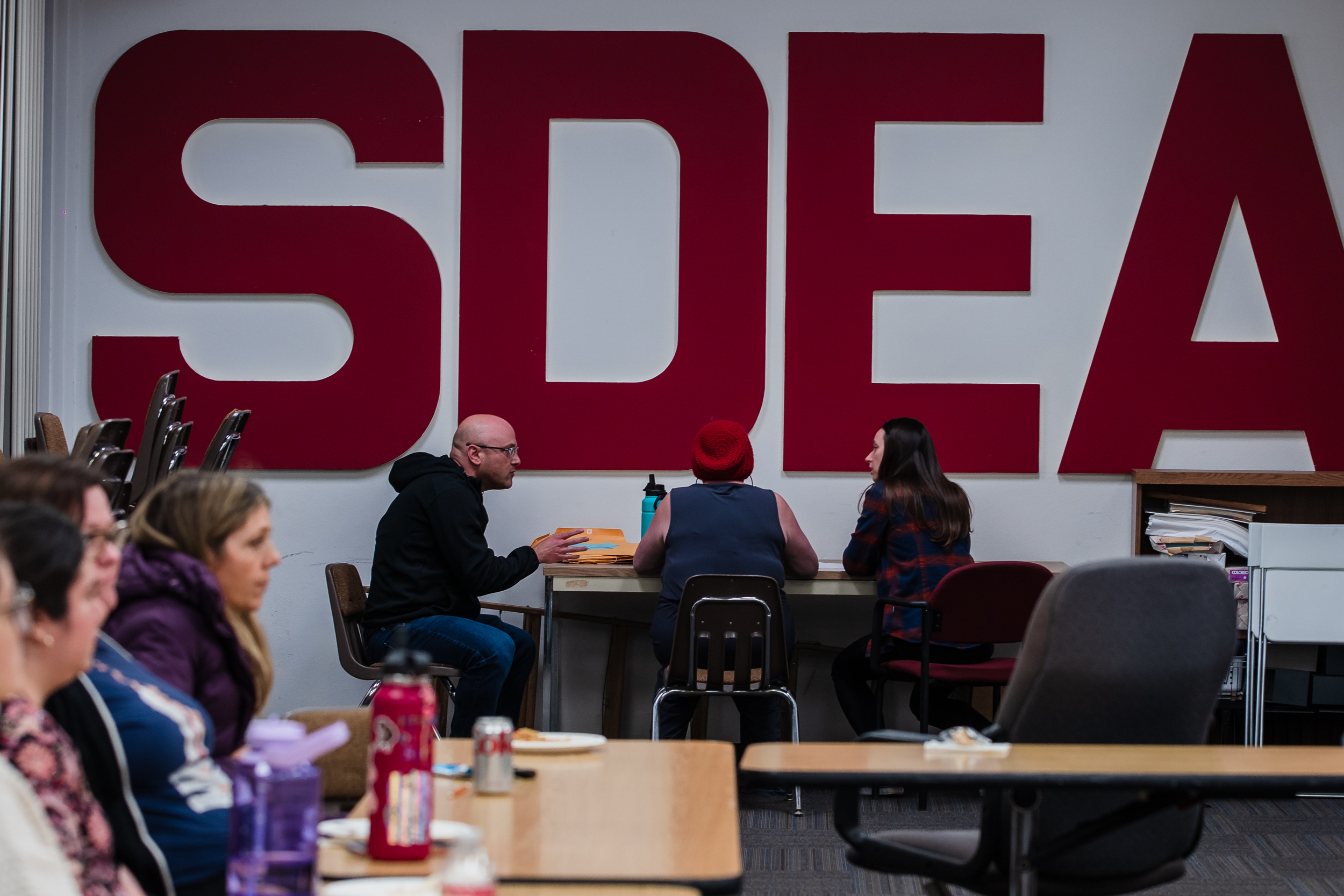


At a San Diego Unified board meeting earlier this month, speakers lined up to decry layoffs proposed by district leadership amid its continued budget crisis. More than 200 positions were set to be eliminated. These were what’s known as classified staff — everyone from custodians to classroom aides to secretaries and more.
Throughout the public comment period, many attendees remained standing in a show of support. Then Kyle Weinberg rose to speak in opposition to the layoffs. As he walked to the podium, dozens of people sat down.
Some in the room felt Weinberg had not only contributed to a growing divide in the district’s labor sphere, but that the raises he’d helped secure for teachers were to blame for the layoffs. It was a striking rebuke for Weinberg, who for eight years, has led the San Diego Education Association, which represents district teachers. It all comes as he runs for a third term atop the district’s most powerful union.
“When (Weinberg) makes comments that we’re in solidarity and we have been for a long time, that’s disingenuous,” said Dawn Basques, the president of San Diego Unified’s Office-Technical and Business Services union. Hers is one of the unions whose members’ jobs were being cut. “It’s not just that there hasn’t been solidarity, it’s that what he’s done has hurt our members.”
Ultimately, staff lost the battle. The board unanimously approved the layoffs. But that added fuel to a fire that, until then had mostly simmered under the surface.
Now, as teachers vote on new union leadership and a contract that some directly tie to the layoffs of classified staff, what was once internal turmoil is spilling into open view. The anger over the layoffs, and Wenberg’s perceived role, could lead to new faces at the top of SDEA. It may also change the way SDEA – and its sibling unions – approach labor negotiations moving forward.
The Labor Imbalance

When it comes to San Diego Unified labor negotiations, there’s really only one game in town – SDEA. The union is by far the most powerful and influential in the district and has been for years.
It’s the only union whose president and vice president get to go on paid leave to do their work. It’s also the only union that plays an active role in elections for the five district trustees.
For the members of the district’s other unions, that power imbalance plays out both in schools each day and at the bargaining table, where they often feel like an afterthought, said Ed Lovato, president of the district’s Operations Support-Services union. He represents everyone from maintenance workers to custodians.
“They say no to us all day long, but they can’t say no to the teachers. They give them everything they want,” Lovato said. “You could just call us slave one, slave two and slave three, because that’s how they look at us,” he said, referring to himself, Basques and Miguel Arellano, the president of the district’s paraeducators union.
But the teachers’ negotiating power has historically helped classified staff. That’s because the district has what’s called a me-too bargaining clause that guarantees that if one bargaining unit secures a raise, other units receive corresponding raises. So, even if classified unions didn’t have the juice to negotiate raises on their own, they could usually rely on teachers to do the heavy lifting.
But their fates being tied to the teachers union has meant they’ve had to just put up with whatever SDEA negotiates, even if it hurts their members. And according to them, it has.
‘Stepping on Classified’
The tentative agreement district officials reached with SDEA is a plum deal. At least for teachers.
It grants them – and by virtue of the me-too clause, all other district employees – 2.5 percent raises this year. It will also give them an additional 2.5 percent raise next year, assuming funding comes in as expected. But San Diego Unified is grappling with a structural budget deficit that’s reached the tens of millions.
Another stipulation in the contract has caused additional heartburn: a promise that no certificated teachers will be laid off. But someone has to go, San Diego Unified Trustee Cody Petterson said in a recent interview on the VOSD Podcast. That’s where the trouble for classified staff really kicks in.
“You basically have to close positions or give raises – you pay more people less or less people more,” Petterson said. “There’s no other third way.”
For many teachers, that trade off came as a shock. The pushback against the layoffs has been so significant that some teachers have threatened to vote down their own raises if it could mean keeping their classified colleagues.
“The realization that our contract is why we’re going to lose our classified colleagues is hitting our membership like a ton of bricks,” said Shane Parmely, a longtime San Diego Unified educator and union activist. “It’s motivated a lot of people to run (for union leadership) and it opened a lot of board members’ eyes to the blatant disinformation that they’ve been fed by our union president.”
That shock was amplified because the contract’s impact seemed to run counter to the union’s rationale for its proposed strike in February. SDEA leadership pitched the proposed strike as pressuring district administration to fully staff special education amid an ongoing unfair labor practice charge related to case managers being stuck with caseloads over their limit.
But while SDEA was able to negotiate stipends for their members who are over caseload limits, the layoffs will likely eliminate the jobs of some of the classified staff who work alongside them in special education. Those include staff like paraeducators, who act as teacher aides on everything from managing student behavior to leading small instructional groups.
While initial notices were issued, districts leaders will determine exactly which positions will be eliminated in the coming months.
“They bargained for a stipend that’s worth more than a para educator makes that would be able to help out with their caseload,” Arellano said. “Things are going to get worse because there’s more students that require services and there’s not enough people to work with them.”
Parmely put it simply: “The strike was sold to us as fully staffing special education, but it wasn’t. It was about fully staffing SDEA.”
Weinberg disputes that claim, saying fully staffing schools means fully staffing classified staff as well.
“We support our classified siblings in their push to be fully staffed and to push back on the layoffs. We also believe that the layoffs are unnecessary to balance the budget,” he said.
But what also came as a surprise to teachers was the fractured relationship between the district’s classified unions and SDEA. Many had assumed the unions had worked together to negotiate the latest contract, but Arellano, Basques and Lovato said Weinberg completely cut them out of the process.
In fact, it wasn’t until a couple of months ago that members of the SDEA’s board found out that the relationship between their union and the classified unions had deteriorated so completely that some of the heads of the classified unions hadn’t had meaningful conversations with Weinberg in more than a year.
“If Kyle was smart, he would have all of us together and we all would have conquered this beast. Instead, he just left us to sink,” Lovato said. “They should have all known there was a problem and maybe attempted to work with us on the solution, but I feel like nobody around him knew.”
All three classified heads point to the same reason for the distance between their unions and SDEA – Weinberg. In their telling, he’s repeatedly misled them and negotiated in ways that have explicitly harmed their members.
“I started recognizing a pattern that this was someone who does not care how he gets what he gets and has no problem stepping on classified to do it. It grew to the point that we could no longer trust that we could work together.” Basques said. “Across the district, we’re not really valued and unfortunately, that’s what Kyle (Weinberg) has emulated.”
Weinberg did not directly respond to the claims by Basques and the other classified union heads, but he said that “we at SDEA are a social justice union and member of the Labor Council, along with CSEA. Our goal is always to collaborate with our local sister unions whenever possible because we truly believe that together we are stronger.”
‘We Have to Do This Together’
It’s in that charged atmosphere that the elections for SDEA’s leadership – and a vote on the controversial contract – have unfolded. Both elections began last week and run through the end of this week.
At least two slates of candidates are challenging Weinberg for what would be his third term, both of which feature familiar faces. Of SDEA’s 15 current officers and board members, none are running as part of Weinberg’s “People Power” slate.
Current SDEA Treasurer Lisa Morris is running on a two-person slate with board member Amy Childs, for president and vice president respectively.
But it’s been the members of the “Good Trouble” caucus led by SDEA’s current vice president, Monique Barrett who have been some of the loudest critics of both Weinberg and the negotiation tactics that produced the latest contract. The caucus also includes three other currently serving board members.
Barrett thinks the union should start approaching their work differently and work more closely with district families to figure out how to really move the needle. Doing that, though, requires thinking outside of the box.
“If you look at what’s happened to our students – our Black families south of the 8 – how have we as SDEA helped them?” Barrett asked. “We need to be asking ‘do we really want a raise?’ But we never ask that question.”
But she also thinks the union is in need of greater transparency and accountability. That’s especially true when it comes to Weinberg, who she said not only abandoned classified staff, but misled SDEA members about it. Barrett, on the other hand, has built a close relationship with the classified unions.
“He’s lied to our board and said SDEA stood by and supported classified staff. But in negotiations it was all about SDEA,” Barrett said. “If we want to build and make the district and board members bend to the will of the people, we have to do this together and align our priorities together and stand united. That includes the classified staff.”
Weinberg also disputes that characterization, saying he strives to be open and transparent.
“There have not been any intentional efforts to hide any information from anyone,” he said.
Even given the disillusionment, Weinberg’s challengers likely have their work cut out for them. His track record features some significant victories, not least of which is nearly 20 percent wage increases. He also touts the buildout of dozens of community schools, the passage of workforce housing, the establishment of a safe sleeping site, protection of fully paid family health benefits and more.
“We want to be keep that progress going,” Weinberg said.
But SDEA isn’t the only union that may come out on the other end of this turmoil changed. For the heads of the three classified unions, the experience has shown them they can’t continue to rely on SDEA. What they need is to embrace each other and build their own power base.
It won’t be easy. The dependence on SDEA has existed for a long time, but the trio have already begun to align their goals in an attempt to step out of their big sibling’s shadow. Already, that unity has made them feel stronger – and more important – than ever before.
“This culture needs to change. All of us are important and we should work together,” Basques said.
“We’ve been the invisible workers for a long time,” Arellano replied.
“But I don’t think we should be invisible anymore,” Basques added.
The post San Diego Unified Teachers Almost Walked Out for Special Ed Staff. They May End Up with Less appeared first on Voice of San Diego.