Sacramento Report: Two Gubernatorial Candidates on Tijuana River Pollution
 EM - News Moderator



For years, local officials and environmentalists in South San Diego County — where sewage entering from Mexico has polluted the shores for decades — have suggested that the state has not deployed enough resources to address the soiled waters of the Tijuana River.
Nearly $700 million in federal money since 2022 has been sent to the U.S. International Boundary and Water Commission, the national agency in charge of cross-border rivers, to upgrade deteriorating American water treatment plants near the border.
At the state level, San Diego lawmakers in January helped secure $30 million toward river cleanup projects.
County officials have repeatedly asked the Newsom administration to declare a state of emergency at the site to deliver more state funding. Supervisor Paloma Aguirre, who has led this initiative, says doing so would allow for water treatment plant improvements to capture and stop sewage before it enters the United States.
Emergency proclamations are typically made when a natural disaster is too extreme for a city or county to handle on its own. Gov. Gavin Newsom declared more than a dozen last year for various windstorms and wildfires.
The resources deployed for emergencies can be costly, and California faces a yearslong multi-billion dollar budget deficit that’s expected to worsen because of federal funding cuts to social services such as the state’s Medicaid program.
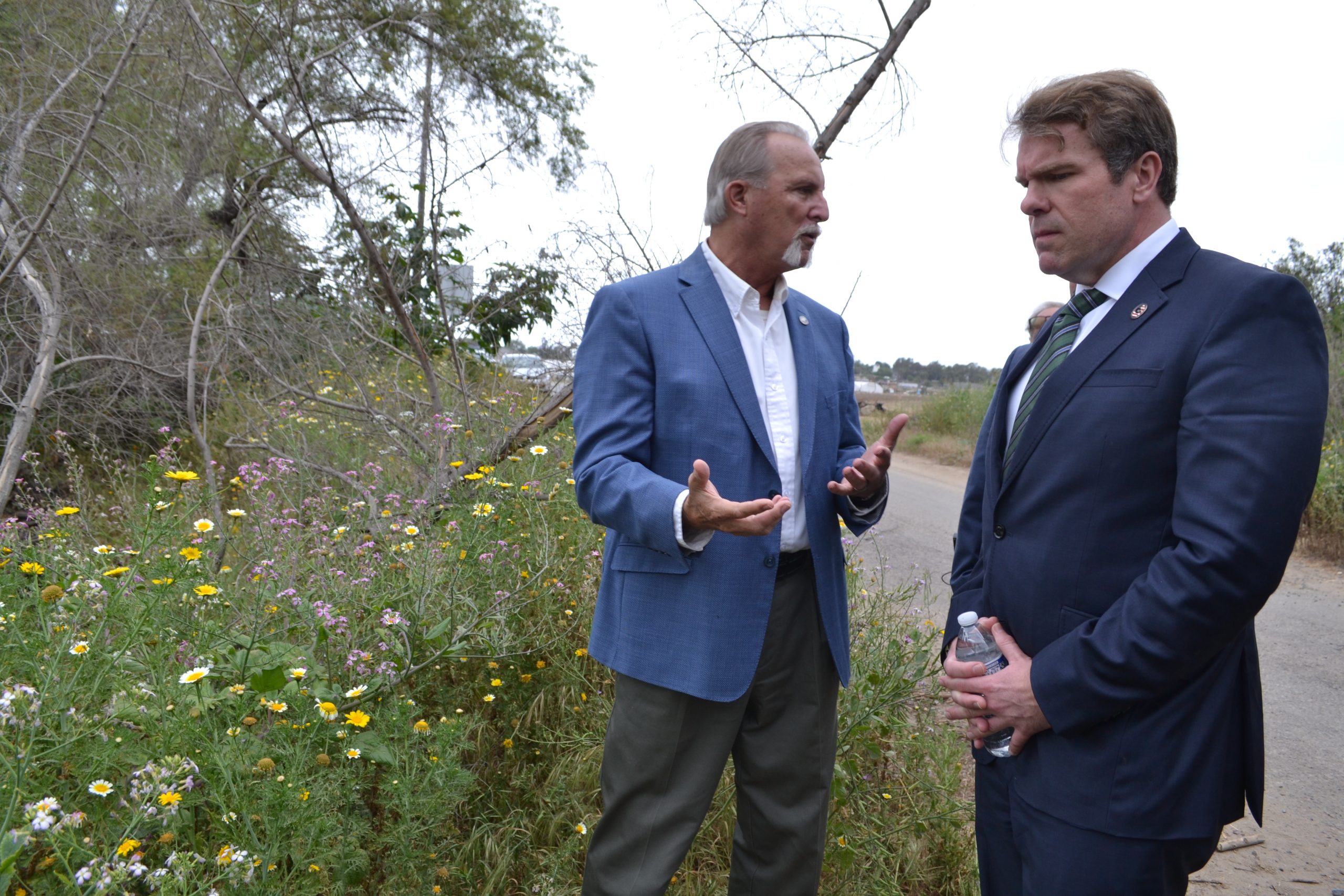
Some of the eight Democrats running for governor have visited the site in recent weeks with county officials to offer what they’d do about the millions of tons of sewage sickening thousands of residents.
Billionaire and former presidential hopeful Tom Steyer was the latest to see the site in San Diego this week and he, along with three other Democrats who have visited — former state Controller Betty Yee, San Jose Mayor Matt Mahan and former U.S. Rep. Katie Porter — said he would declare the disaster a state of emergency. Former U.S. Health and Human Services Secretary Xavier Becerra does not think the state should declare an emergency because of the costs that could come with it..
Advocates want the next governor to do everything possible to get more resources for the river.
“Whoever comes out who is the biggest environmental champion, who has a direct focus on the Tijuana River, is somebody that we feel strongly that we would like to see leading the governor’s office,” said Mark West, director of the San Diego Sierra Club, which has not endorsed a candidate.
I spoke with Democratic gubernatorial candidates Betty Yee and Becerra, separately, about their thoughts on the state’s role in cleaning up the river pollution, as each have worked on issues related to it in their former roles.
Below is my conversation with Yee, edited for length and clarity.
You recently visited the Tijuana River with county officials who say a state emergency proclamation is the next step for funneling more resources. Is that what you’d like to do?
I feel like a public health emergency would marshal all the resources of the state to just be pinpointed to that area because the public health consequences are very dire.
I was visiting a school when I was down there as well. A lot of the kids have to stay indoors because it’s not just a water pollution issue, it’s an air quality issue. So, all of that says to me — kids getting headaches, missing school — we just can’t let this happen.
Do you think the state could be doing more?
I don’t think the state has done much. I think they may have sent some people down there from the agency (California State Lands Commission), but in terms of really marshalling resources to help, I don’t think they’ve done or even been in touch with the Trump administration.
Why do you think that’s the case?
It’s a border town. It’s a border area. I mean, to a large extent, it really does require federal intervention, but we should be asserting much more what needs to happen.
If this happened anywhere else, if it wasn’t the communities that they are, we probably would have gotten some attention.
So your priority would be to declare an emergency to allow for more state resources?
Right. And it may not even be money. It could just be information for families to know how to stay safe. I just hope we can come up with some alternatives so that while hopefully we’re fixing this, this is not going to continue to damage the health of the families there.
My conversation with Becerra, edited for length and clarity:
You have plans to visit the river later this month. What do you think needs to be done?
I worked on it when I was AG. We sued the federal government because we didn’t believe the binational commission (International Boundary and Water Commission) was doing enough, and it has to be done binationally. The federal government has to come in, we can’t do it by ourselves.
The state of California is ready to help. San Diego is ready to help. But we need the federal government to step up.
A lot of people have thrown around the idea of declaring a state of emergency. What would your priority be?
What I would not want to do is raise expectations by, for example, declaring a state of emergency because a state of emergency gives everyone the sense that you’re breaking glass and going right at it.
I don’t want the state of California to foot the bill for what the federal government should be forking over. I don’t want to give people the sense that we’re going to solve it by ourselves. It’s too expensive and it’s not just on us. So if the federal government declared a state of emergency, that’d be different.
We’ve got deficits. We’ve got a housing crisis. We’ve got a health care crisis. So can I guarantee that we have the resources by declaring a state of emergency? If I thought that would work, I’d do it.
But you’re saying it’s too expensive?
It’s enormous, and it’s a national issue. It’s between two governments, the U.S. and Mexico. It’s not California’s fault that Mexico and the U.S. haven’t resolved how they’re going to deal with this. And it shouldn’t just be on California to come up with the money to solve it. We will do our fair share, and the locals will do their share as well. But the feds have to be there.
In Other News
Lawmakers return next week from spring break. Here’s what I’ll be watching:
- A bill, AB 1406, that would make it easier for developers to charge condo buyers more for deposits. It was introduced by Assembly Democrat Chris Ward. It faces one key hurdle before it lands on the governor’s desk.
- Legislation to exempt a long-delayed San Diego stadium project from environmental review. The proposal, SB 958, was authored by Sen. Akilah Weber Pierson, who represents part of the Midway District where the project will be built.
What I’m Reading Now
In the Trump era, wealthy Democrats are working harder to obscure their donations to liberal causes, The New York Times investigates.
California joined 23 states in a lawsuit challenging President Donald Trump’s executive order to create a national voter list meant to restrict mail-in voting, The Sacramento Bee writes.
Breakups are never easy. They’re even harder when pets are involved. The Los Angeles Times speaks to couples about what happens when we need to split custody of our feline and canine friends.
Thanks for reading the Sacramento Report. Please reach me at nadia@voiceofsandiego for any comments.
The post Sacramento Report: Two Gubernatorial Candidates on Tijuana River Pollution appeared first on Voice of San Diego.