Politics Report: Could the City Lose Liberty Station?
 EM - News Moderator


Imagine the city of San Diego selling the sprawling campus of Liberty Station for $2.7 million.
What do the buyers think this is? A four-bedroom house in Point Loma?
As astonishing as that number sounds, that is the actual offer on the table.
And it’s not just an offer on the table. The company that wants to buy most of Liberty Station, called Seligman Properties, is doing everything it can to force the sale — in court and by other means.
How We Got Here
Why would a city, or anyone else for that matter, have to sell a property they didn’t want to?
In this case, it’s because Liberty Station isn’t a normal property. After its life as Naval Training Center, one of San Diego’s redevelopment agencies became the owner of Liberty Station. Redevelopment agencies were quasi-public institutions — and as Voice of San Diego reported, quite a few of them got involved in some shady activity. Gov. Jerry Brown got rid of them in 2012 and their properties went to local governments, known as successor agencies.
Here was the catch: Government agencies didn’t get to just keep the properties. They either had to sell or come up with future plans for the sites they now owned. They couldn’t just sit on them.
The city got 38 properties, the Union-Tribune reported. City leaders decided to keep 22 of them, including Liberty Station, which meant they had to designate the sites as being intended for future development.
Enter Seligman: Seligman is the largest leaseholder in Liberty Station. It leases roughly 330,000 square feet of commercial space from the city, which it, in turn, leases to other businesses. But Seligman doesn’t want to just lease. It wants to own its part of Liberty Station.
Seligman sued the city, arguing it isn’t actually making plans for the future development of Liberty Station — meaning the city should be forced to sell.
Why the Lowball?
Seligman is offering the city a little more than $2 million, as the U-T reported in March. (The full offer comes to $2.7 million, because other renters at Liberty Station have also offered to buy.)
Seligman’s offer amounts to roughly $6 per square foot — exponentially lower than average. How did they get such a number?
Well, it’s because they are already the beneficiaries of an incredible lease deal with the city, which doesn’t begin to expire until the late 2060’s — and which essentially devalues the whole property.
Seligman leases it’s 330,000 square feet from the city for a dollar a year. Yes, $1 per year. That means anyone who buys the property from the city will become the owner of a worthless lease — and be stuck with it for decades.
So, where did that lease come from?
The former redevelopment agency entered into the lease with a company called McMillin-NTC in 2000, a representative from the Independent Budget Analyst’s office told me. McMillin redeveloped the entire area and, in exchange, got an incredible deal: 330,000 square feet for $1 per year.
In 2018, McMillin sold its lease to Seligman. And now Seligman doesn’t just want the right to lease the properties to other companies. It wants to own the properties outright.
The city has not taken kindly to Seligman’s offer, which it says would only serve to enrich the company, as the U-T has done a good job explaining.
The fight, however, isn’t just as simple as the city versus Seligman.
Split It 14 Ways
The city isn’t the only government agency involved in this whole deal.
A full 13 government agencies — as well as an educational fund — were the beneficiaries of tax revenue from Liberty Station. They are all entitled to a cut of riches from the property. The chart below lays out what percentage each one can claim.
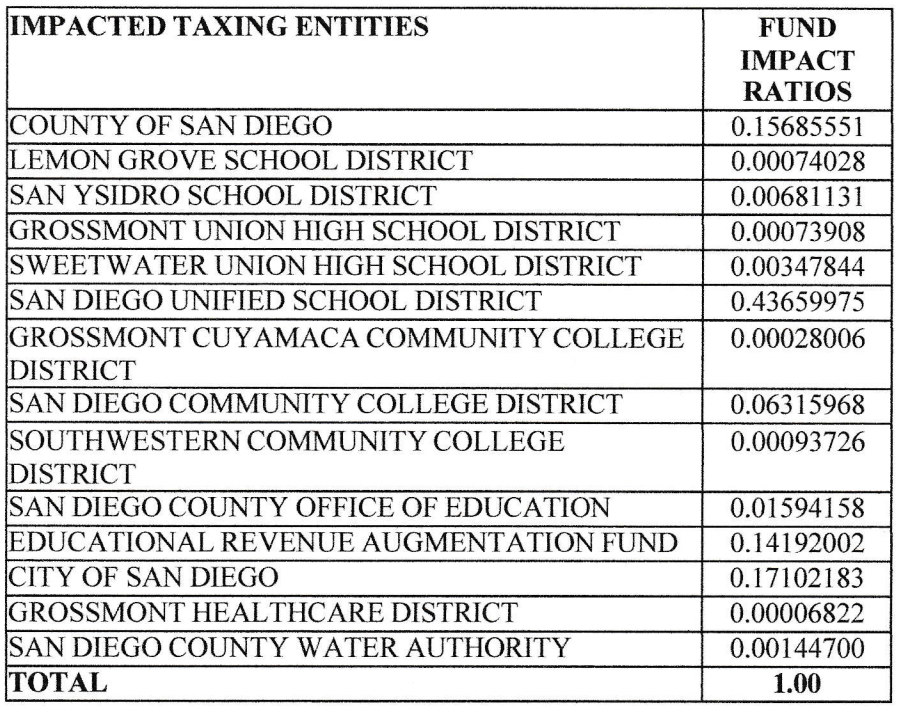
A crucial part of showing the court that it is moving forward with “future development plans” is for the city to pay off each of these entities, so it can hold the property unencumbered.
Three of the agencies are now holding that up.
San Diego Unified is supposed to get by far the biggest cut of the revenue. And as the U-T reported earlier this week, its board just punted on the city’s proposed payout.
“It’s not that I don’t trust the city, but I don’t trust the city,” said Trustee Sharon Whitehurst-Payne.
It’s understandable that San Diego Unified delayed its decision — in part because Seligman may not be the only one making lowball offers.
City leaders offered San Diego Unified just $1.4 million to come to an agreement. They came up with that number based on an appraisal of the property’s value from 2011.
Company leaders at Seligman have reached out to all the government agencies and asked them to think carefully about the deal.
They told San Diego Unified trustees they should be asking for closer to $10 million, which is ironic since Seligman is only offering the city $2 million. (Company leaders say they have plans to reappraise the property, which indicates they may raise their bid to the city. As far as the property’s worth goes, it’s also worth noting that Seligman paid $159 million to acquire the lease from McMillin in 2018, according to the U-T.)
San Diego Unified isn’t the only holdout. Both, San Ysidro School District and Southwestern Community College are also hitting pause on their decision, Seligman representatives say.
As if the deal isn’t complicated enough by the sheer number of government agencies involved, there is yet another factor: the state of their finances.
Most government agencies find themselves in dark budget times. The city of San Diego and San Diego Unified both have brutal budget deficits to fix. Some others are even worse off. San Ysidro School District is on the verge of insolvency. Just a couple of elected representatives outside the city of San Diego could have the power to swing this deal.
All that adds to Seligman’s leverage.
But in the meantime, the city of San Diego isn’t in a bad position either. Its name remains on the deed and the judge in the case has indicated it would be difficult to force a time table on the situation.
The post Politics Report: Could the City Lose Liberty Station? appeared first on Voice of San Diego.