Inflation to remain above BSP target amid looming El Niño, rising commodity costs
 EM - News Moderator


By Pexcel John Bacon
INFLATION in the Philippines is expected to remain elevated through the rest of 2026 as rising global commodity prices, supply disruptions linked to the Middle East war, weather-related risks and domestic production constraints continue to push up costs, according to a discussion paper by the Congressional Policy and Budget Research Department (CPBRD).
The House research arm projected inflation could range from 6.37% to 7.32% in the third quarter and from 5.91% to 7.31% in the fourth quarter, remaining well above the Bangko Sentral ng Pilipinas’ (BSP) 2%-4% target.
“Even with volatility, it is highly unlikely that inflation will fall below 6% in 2026,” the think tank said.
Inflation remained above the central bank’s goal for the fifth consecutive month in July. However, easing oil prices and better food supply conditions helped inflation ease to 6.2% during the month, but the seven-month inflation average stood at 5%.
The CPBRD noted that said multilateral institutions’ projected 2026 inflation rates for the Philippines, which range from 4.2% to 6%, are the highest among five Association of Southeast Asian Nations (ASEAN) members.
“Across the four multilateral institutions, expectations in the change of commodity prices on average will almost reach 6% for 2026 from an original estimate of around 3%, or double than the initial estimates for the Philippines followed by Thailand, Vietnam and Singapore,” it said.
The BSP sees headline inflation averaging 6.4% this year, before easing to 4.5% in 2027 and 3.1% in 2028.
“(Inflation) risks to the upside include weaker-than-expected harvests in Q3 and Q4 (particularly due to the monsoon, a super El Niño, and fertilizer constraints) and continued commodity supply constraints arising from the Iran war,” CPBRD said.
If the super El Niño persists until early 2027, it said that the drop in agricultural output may drive up prices on rice, corn, vegetables and livestock feed.
“Lower reservoir levels may likewise constrain hydropower generation, increasing reliance on more expensive thermal power plants and placing further upward pressure on electricity prices,” it said.
The think tank also noted the continued depreciation of the peso drives up the cost of imported fuel, fertilizers, food commodities, industrial inputs, and capital goods.
“Given the Philippines’ reliance on imported energy and agricultural inputs, sustained peso weakness could amplify imported inflation and delay the return of headline inflation toward target,” it said.
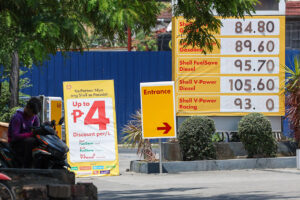
The CPBRD also noted that inflationary pressures have intensified due to soaring oil prices and shipping disruptions since the Middle East conflict started in late February.
“These disruptions could increase the landed cost of imported fuel, fertilizers, grains, and other intermediate inputs, resulting in broader cost-push inflation across agriculture, manufacturing, and transportation,” it said.
A hike in daily wages could also generate additional inflationary pressures, as businesses pass on higher operating costs to consumers, the CPBRD said.
To address persistent inflationary pressures, the CPBRD said the government should consider “a more conservative fiscal policy which involves a leaner, smart National Budget to avoid more taxes which are non-deflationary in nature.”
The think tank said the government should focus on increasing the supply of goods and services, including strengthening domestic food production, developing a more resilient energy grid and adopting affordable and reliable mass transportation.
John Paolo R. Rivera, a senior research fellow at the Philippine Institute for Development Studies, said fiscal restraint would be feasible if the government distinguishes between productive spending and lower-priority or poorly executed expenditures.
“The objective should not be across-the-board cuts, but better prioritization protecting targeted assistance for vulnerable households while improving the efficiency of spending elsewhere,” Mr. Rivera said in a Viber message.
He said fiscal policy could be more effective in addressing inflation if price pressures are largely supply-driven, noting that monetary policy has limitations in dealing with supply constraints.
“Higher interest rates can restrain demand and anchor expectations, but they cannot produce food, lower electricity costs, or fix supply bottlenecks,” Mr. Rivera said, adding that fiscal policy can directly address price pressures through “targeted subsidies, logistics improvements, and supply-side interventions.”
Former Finance Undersecretary Cielo D. Magno cautioned that fiscal restraint should not come at the expense of government spending on development priorities, particularly as economic growth slows.
“Fiscal restraint should not constrain government from spending on development priorities, especially when the growth rate is slowing down,” Ms. Magno said in a Viber message.
Calixto V. Chikiamco, president of the Foundation for Economic Freedom, said fiscal conservatism may be ineffective in addressing inflation driven by supply-side constraints.
“Fiscal conservatism is a poor and inefficient tool to curb supply side cost push inflation,” Mr. Chikiamco said in a Viber message. “Fiscal conservatism seeks to curb demand when it’s supply side shortages or broken supply chains that’s causing the problem.”
He said the government should instead focus on measures that increase supply, including easing restrictions on agricultural imports and lowering tariffs.