Historic return to the Moon culminates in dramatic splashdown off San Diego
 Dante Ulanday - News Moderator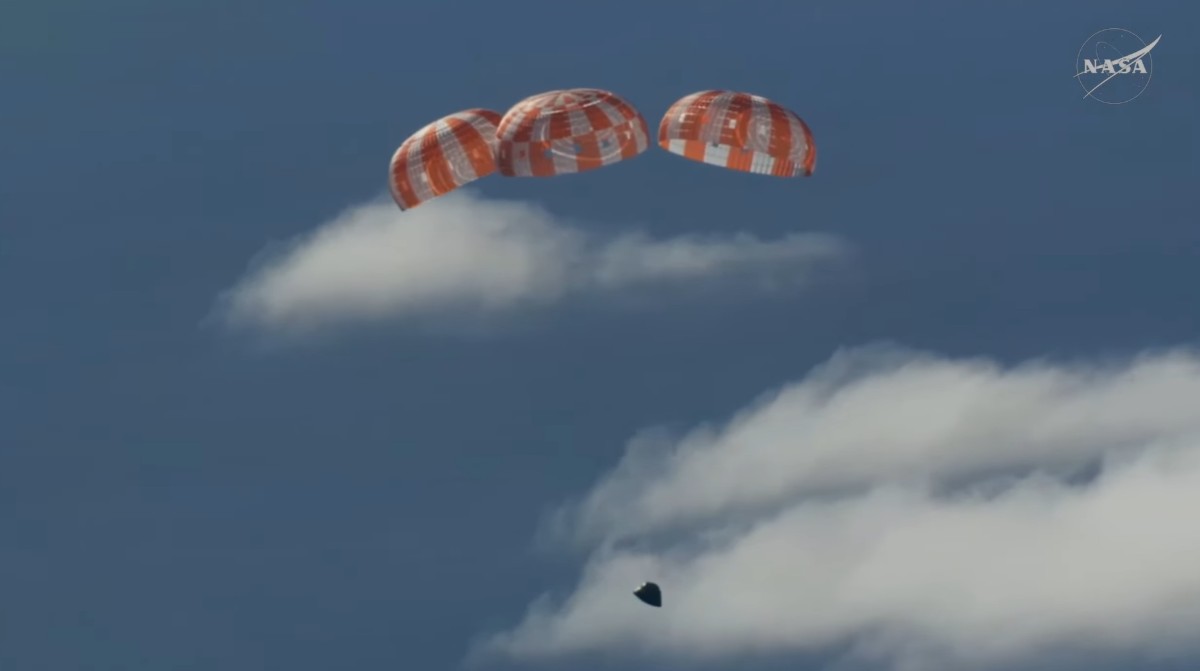



The first crewed flight to the Moon in over 50 years ended at 5:07 p.m. Friday with a successful splashdown in the Pacific Ocean off San Diego.
After a fiery re-entry, the four Artemis II astronauts in the Orion Capusle — NASA’s Reid Wiseman, Victor Glover and Christina Koch, and the Canadian Space Agency’s Jeremy Hansen — landed under three giant parachutes amid clear Pacific skies.
Re-entry into Earth’s atmosphere began at 4:53 p.m. southeast of Hawaii, with friction raising the temperature around the Orion to 3,000 degrees and cutting radio communion for six minutes.
Just after 5:01 p.m., Koch called in, confirming the capsule had successfully made it through the most stressful part of the re-entry.
Live video from aircraft showed drogue parachutes unfurling, then the main chutes opening to gently lower the capsule into the ocean.

Moments after the splashdown, NASA confirmed that the four astronauts were in “good “excellent condition.”
“This is the just beginning,” said NASA Administrator Jacob Isaacman after the landing. “We’re going to get back into this with frequency, sending missions to the moon.”
After the splashdown, a communications glitch prevented the astronauts from powering down the capsule so that Navy divers could immediately approach.
Just before 6 p.m., the divers approached to assist the astronauts onto an inflatable raft, and then up to MH-60S SeaHawk helicopters to fly them to the nearby USS John P. Murtha, an amphibious transport dock ship from Naval Base San Diego. After safety checks, the first astronaut, Koch, emerged from the capsule at 6:33 p.m. Four minutes later, all four were out.

Aboard the Murtha, the astronauts will be checked by doctors in the warship’s medical bay.
The four will then be flown to North Island, where awaiting aircraft will take them to NASA’s Johnson Space Center in Houston.
There was a chance that the returning spacecraft could be seen as a brief flash from coastal San Diego, and a crowd gathered at Windansea Beach, but there was heavy cloud cover.
Amanda Finnie, a La Jolla resident, was hoping to see the historic event. “I’m here today to watch history and watch a rocket ship land. I don’t think I’m going to be able to see it, but I think I’ll be able to hear it,” she said.
Thomas Murphy contributed to this article.
Updated at 6:38 p.m., Friday, April 10, 2026