BSP says it can still take monetary action amid looming inflation risks
 EM - News Moderator


By Katherine K. Chan, Reporter
THE Bangko Sentral ng Pilipinas (BSP) left the door open for further monetary policy action as broadening price pressures are expected to keep inflation elevated in the near term, delaying its return to target until 2028.
BSP Governor Eli M. Remolona, Jr. on Monday told lawmakers that inflation may only gradually ease over the medium term as threats of second-round effects continue to cloud their outlook.
“Over the medium term, we expect inflation to ease gradually. However, risks remain tilted to the upside,” Mr. Remolona said during economic managers’ briefing for the 2027 National Expenditure Program at the House of Representatives.
The central bank sees headline inflation averaging 6.4% this year, before easing to 4.5% in 2027 and 3.1% in 2028.
BSP Deputy Governor Zeno Ronald R. Abenoja flagged inflation risks from elevated global oil prices and rising inflation expectations.
“The BSP sees upside inflation risks, and this could emanate largely from the higher global oil prices and higher inflation expectations,” he said. “If you look at private sector inflation forecasts, they will also see higher inflation in the near term. But this could revert to near the 3% level by 2028 or 2029.”
Mr. Remolona noted that they stand ready to adjust their monetary policy further to eventually bring inflation near their 3% target.
Inflation remained above the central bank’s goal for the fifth consecutive month in July. However, easing oil prices and better food supply conditions helped inflation ease to 6.2% during the month, but year-to-date, inflation averaged 5%.
The BSP chief attributed sticky inflation to the continued pass-through of global supply shocks to domestic prices.
“As you know, oil price shocks are not just about energy. They are also about food prices because oil is also the source of much of our fertilizer,” Mr. Remolona said.
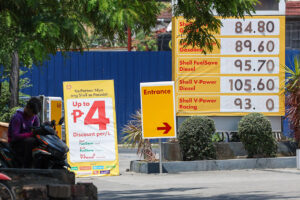
The BSP has held onto its hawkish yet measured stance since the Middle East war erupted in late February. The central bank began tightening in April as the faster-than-expected transmission of oil shocks worsened its inflation outlook.
The Monetary Board has delivered a total of 50 basis points in hikes via two straight meetings, bringing the key policy rate to an over one-year high of 4.75% in June.
“To contain price pressures, the BSP has responded by tightening monetary policy twice this year,” Mr. Remolona said. “These were carefully calibrated moves to help slow down inflation, anchor inflation expectations, while recognizing the temporary weakness in growth.”
Mr. Abenoja likewise noted that their measured approach was set to complement the government’s fiscal measures to ramp up consumption and boost business confidence.
The BSP shifted to a tightening cycle even amid a weak economic growth backdrop since late last year.
Gross domestic product growth slowed to 2.3% in the second quarter, as investments continued to take a toll from the lingering effects of the flood control mess and household spending dampened due to rising consumer prices.
This marked the economy’s worst performance since it contracted by 3.8% in the first quarter of 2021. Excluding the pandemic, it was the slowest growth in over 16 years or since the 1.8% in the fourth quarter of 2009.
“We look at all the evidence and we are prepared to take further steps as necessary to ensure that inflation returns to target,” Mr. Remolona said.
Last week, the central bank governor noted that the dismal second-quarter growth meant they can now be less aggressive in adjusting their monetary policy to curb inflation.
However, Mr. Remolona noted that the inflation fight is still ongoing even as inflation expectations prove broadly well-anchored.
According to Mr. Abenoja, broadening price pressures, as reflected in the sticky core inflation, have weighed on their inflation outlook over the next two years.
“Where do we see inflation going this year and next year in 2027? The inflation outlook has deteriorated amid the challenging external environment and amid the faster-than-expected broadening of price pressures,” he said.
“We can see this, for example, from what we call core inflation numbers. Our analysis points to stronger second round effects and a wider pass-through of earlier supply shocks to the different components of the consumption basket,” he added.
Core inflation cooled for the first time in eight months as it settled at 4.2% in July from the 31-month high of 4.4% in June.
Core inflation excludes volatile oil and food prices, allowing policymakers to determine whether prevailing consumer price movements reflect short-lived disruptions or a long-term trend.
The Monetary Board will hold its fourth regular policy review this year on Aug. 27, with two more to follow on Oct. 22 and Dec. 17.