Border Report: The Cross-Border Effort to Assist Victims of Violence
 EM - News Moderator


Across the country, advocates are worried that the Trump administration’s aggressive immigration policies and anti-immigrant rhetoric are preventing immigrant victims of violence from coming forward.
A December 2025 report from the Alliance for Immigrant Survivors, a national network of advocates and allies, found that about 70 percent of people who work with survivors of domestic violence and human trafficking reported that immigrant survivors are hesitating to come forward because of concerns about deportation and that more than a third reported that survivors they worked with decided to drop cases against their abusers because of those concerns.
The Mexican consulate in San Diego said its staff at the Comprehensive Women’s Care Window observed a 40 percent decrease in requests for assistance from January to July 2025, which it believed to be the result of fears related to immigration consequences.
The Consul General of Mexico in San Diego and the district attorney recently signed an updated agreement to allow for cross-border support for survivors of domestic violence and human trafficking. The two officials believe that having the consulate involved builds trust with immigrant communities and encourages victims to come forward.
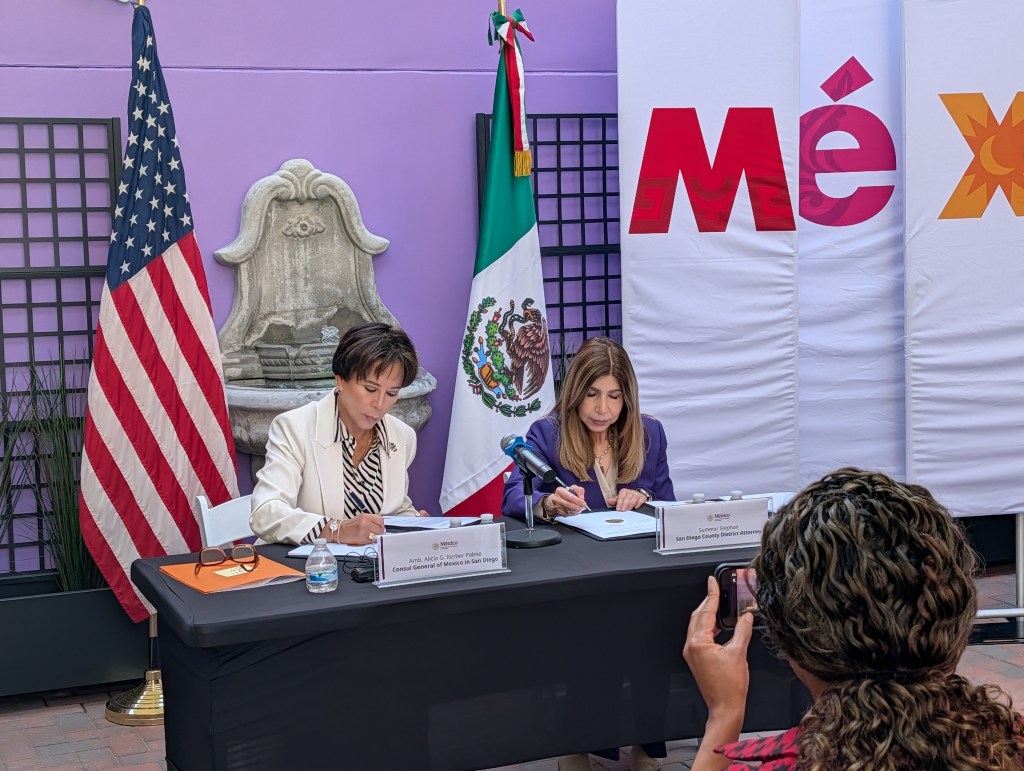
“By joining forces, we reduce barriers, strengthen trust and guarantee that those who need it most have access to legal services, emotional support and community resources regardless of country of origin and regardless, above all, their immigration status,” said Ambassador Alicia Kerber Palma. “This memorandum symbolizes a strategic alliance that prioritizes people.”
“It sends a clear message — ‘You are not alone,’” she added. “‘We are with you, and we believe you.’”
The memorandum of understanding, signed March 26 at the Mexican consulate in Little Italy, gives consulate staff access to two centers that provide services people who have experienced domestic violence, sexual assault, human trafficking or child abuse. The MOU also allows for data sharing.
Kerber Palma said that her team has worked to help immigrant women feel safe coming forward through a campaign launched in August 2025, and that since then, they have seen a 172 percent increase in reported cases at the consulate.
District Attorney Summer Stephan said a woman who recently came to one of the centers, the One Safe Place South County location, lived in Tijuana and needed follow-up services there. Stephan said her office was able to coordinate with the Mexican consulate to ensure that One Safe Place could hand off the woman’s care to a similar organization south of the border.
“There are hundreds of thousands of women and children that live, work, go to school in between both nations,” Stephan said. “They are the responsibility of both Mexico and of San Diego, and what is not negotiable for me as district attorney and my office is to have every child and every woman and every human being to feel safe and protected under our laws here in San Diego.”
Stephan said the two One Safe Place support centers have not seen a drop in foot traffic since President Donald Trump came back into office, but that her staff are watching closely for that to change.
“It’s something that keeps us up at night, but I think the trust relationships we’ve built over the years, they’ve served us well,” Stephan said.
Stephan recently announced labor-trafficking charges against a North County couple who ran elder-care centers.
Stephan said her office’s support centers have contracts with Casa Cornelia Law Center, an immigration legal services nonprofit, to apply for U or T visas for victims who come through their doors and express concerns about their immigration status. Congress created U visas in 2000 to offer protection from deportation for victims of violent crimes, particularly domestic violence, so that they would feel safe coming forward. T visas similarly protect victims of human trafficking.
People often wait years for U visas because Congress allowed only a limited number to be given out each year, and now there is a backlog. T visas take less time but still often require a couple of years of waiting, according to current processing times listed on the U.S. Citizenship and Immigration Services website.
Stephan noted that the One Safe Place centers don’t ask about immigration status, but that concerns often come out in conversation with staff there in the process of survivors telling their stories.
The Trump administration has made changes to U and T visas in the past year, including by telling Immigration and Customs Enforcement officers that they don’t need to check for a pending U or T visa before making an arrest, which has led to some survivors being deported to their abusers.
Advocates have filed lawsuits to stop the policy changes.
Thank you for reading. I’m open for tips, suggestions and feedback on Instagram @katemorrisseyjournalist and on Bluesky @bgirledukate.
In Other News
ICE transfers: Gustavo Solis reported for KPBS that the San Diego sheriff transferred almost three times as many people from jail to ICE custody in 2025 compared with 2024. I reported for Daylight San Diego on the questions that community members had for the sheriff during a recent meeting — and the steps she sometimes took to avoid answering them.
Detention art: For Daylight San Diego, I wrote about the importance of making art for people held in immigration custody.
Indicted agent: A federal grand jury indicted a Border Patrol agent who shot an unarmed, 19-year-old U.S. citizen in Calexico in 2022, Alex Riggins reported for The San Diego Union-Tribune.
Fewer people: San Diego’s population has dropped by more than 5,000 people because of a dramatic decline in immigration, Lori Weisberg and Alexandra Mendoza reported for The San Diego Union-Tribune.
Gas costs: Tijuana has not yet seen a jump in U.S. residents heading south to fill their gas tanks even though the cost of fuel has risen for weeks, Vicente Calderón reported for Tijuana Press.
Cross-border workers: Only 15 cross-border workers have completed the requirements to receive a fast pass to cross the border, Eduardo Jaramillo Castro reported for El Sol de Tijuana.
Detention visit: Reps. Sara Jacobs and Mike Levin visited Otay Mesa Detention Center last week after giving the facility advanced notice, Sofía Mejías-Pascoe reported for inewsource.
Pet registry: The local government in Tecate announced and quickly rescinded a plan to require residents to register and pay for their pets, Punto Norte reported.
Valle bus: Baja California’s wine region in Valle de Guadalupe is getting a bus station to promote more tourism to the area, Adelina Dayebi Pazos reported for El Sol de Tijuana.
Holy Week: Faith leaders gathered at the federal building in the week leading up to Easter to show that they will continue to stand by immigrants, Alexandra Mendoza reported for The San Diego Union-Tribune.
The post Border Report: The Cross-Border Effort to Assist Victims of Violence appeared first on Voice of San Diego.