The Learning Curve: He’s San Diego Unified’s Next Trustee – No Race Needed
 EM - News Moderator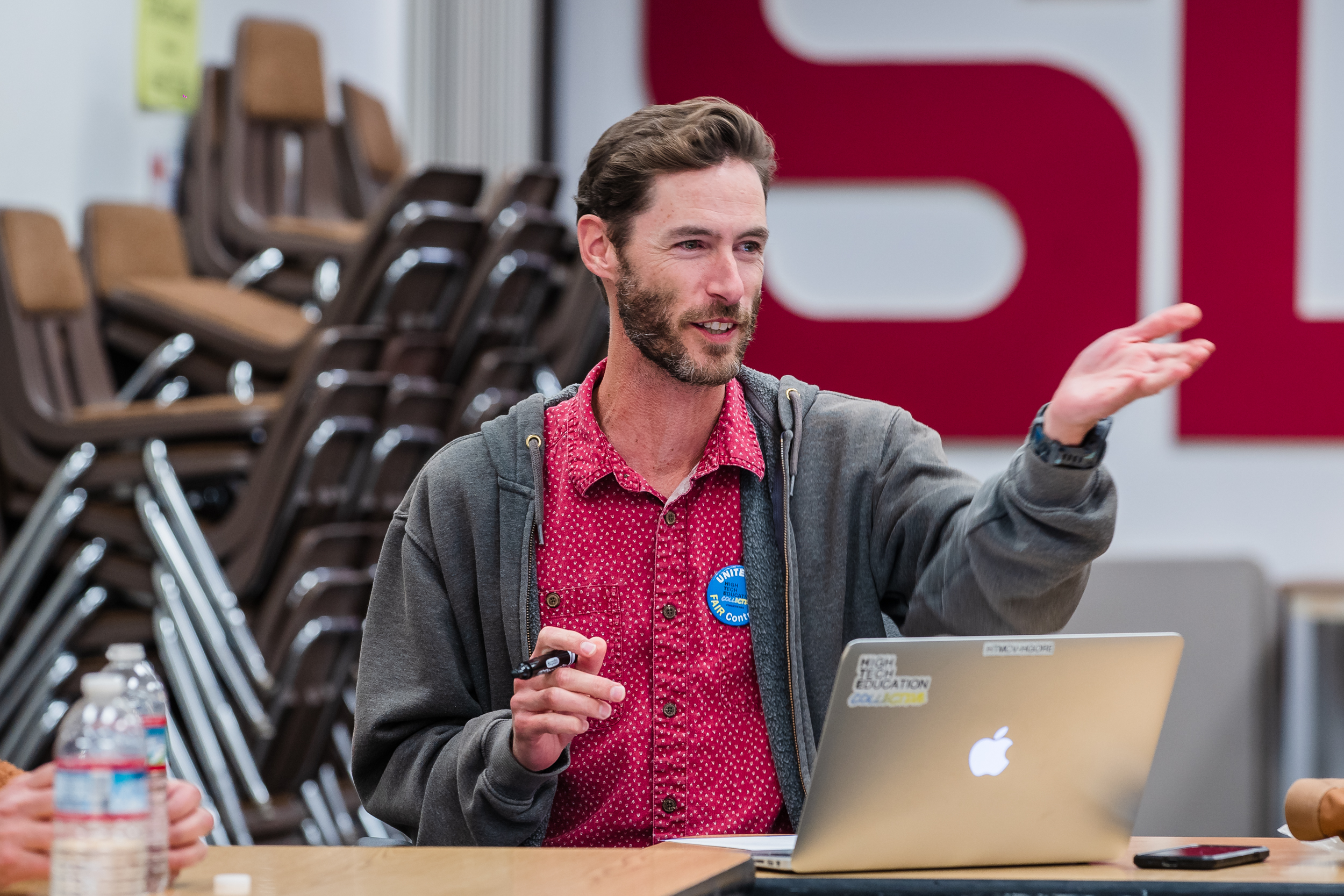


The primary is still nearly a month away. The general election is even further out. Still, it’s already clear that Hayden Gore will be San Diego Unified’s next trustee. That’s because he’s running unopposed to fill the seat left open by current Trustee Cody Petterson, who opted not to run for re-election.
Though he’s a political newcomer, Gore was the early choice of San Diego Unified’s union. In fact, he was recruited by the former president of the San Diego Education Association to run for the seat.
It’s not hard to see why. He’s an avowed progressive and a longtime educator who led the then-newly formed union at High Tech High to its first contract. Exactly the kind of resume that would have SDEA champing at the bit.
But even given SDEA’s glowing endorsement, the next board member for San Diego Unified’s coastal region is a relative unknown to the public. So, I put some questions to him to give people an idea of what he’s all about.
Our conversation has been edited for length and clarity.
Q: We first met back when you were leading High Tech High’s newly formed teachers union during the negotiations for your first contract. It was super contentious. Tell me a bit about what you learned.
What I learned about leadership is that people want someone who is willing to fight for them.
I feel like that is a great lesson in leadership – to really put yourself in service of others. Whatever we do as leaders, we should do it in service of the good of others and the greater good and not be motivated by ego or self-aggrandizement. The union is a perfect example of that, because through the exercise of our collective power we were able to achieve transformational change for our teachers and support staff and, ultimately, our students.
Q: Hit me with your top three priorities as a board member – the stuff that, when you get to the end of your first term, you expect that you’ll have accomplished.
We have to be honest about the political moment that we’re living in right now. Public education is truly under attack, and what we need are school board members who will continue to stand up and protect and defend our students in our schools and our community.
When it comes to my top three priorities, number one is making sure that we continue to invest as much of our resources as we can in the classroom, where we know it has the greatest impact on student success.
Number two is to continue to do the important work the board has started to develop workforce housing and housing for families and students.
The district has lost almost 10,000 students over the last decade, and that creates a situation where we are de facto defunding our schools. I think that’s an incredibly innovative approach to solving this very serious crisis and alleviating some of the pressures that our families are experiencing living in America’s most expensive city.
The other thing is to continue to be a very active and vocal proponent for state and local ballot initiatives that will increase funding for our schools, so that our schools are in the best shape … and our students have all of the academic services, mental health services and social services they deserve.
If I could add a fourth one … our schools are under threat, and it’s a palpable threat that our families and students feel.
It is important for us to defend our schools from the predations of ICE and ICE raids, which are really traumatizing and threatening our students with the possibility of family separation. Kids cannot learn unless they have a sense of physical and psychological safety.
Q: Having worked at High Tech High, a hub of project-based learning, you’ve experienced alternate educational models. Do you think there are opportunities to embrace new approaches to learning that could bring back families who’ve left? I’m particularly thinking of families south of the I-8, south of the 94 who’ve long chosen charters over traditional district-run schools.
Absolutely.
A lot of us have this kind of calcified image in our mind of what public education is, and it’s what we experienced as children, 20, 30, 40, years ago. But society has changed dramatically since then, and we as educators are forced to now more than ever, adapt and change to the needs of our kids and the needs of society.
The best educational model is the one that is flexible, that’s nimble and responsive to the needs of its community. If there are programs that are successful, that are highly desirable, that are models that we can build off of to increase the student engagement, student motivation, to inspire wonder and curiosity, we should absolutely embrace them.
Q: Speaking of calcified, the educational achievement gap is alive and well at district schools. Wealthy students outperform poor ones. White and Asian students outperform Black and Latino students. This is largely a function of societal inequities, but it’s exactly the kind of thing that school districts are supposed to counteract. What strategies do you think could move the needle?
In many ways, public education is the biggest equity project this nation has ever undertaken. But the responsibilities are immense, given the inequities that are embedded in our society.
I think, as an educator, the most effective way to address some of those gaps and outcomes is to create a learning environment which really puts the student at the center of the learning experience, that utilizes and leverages their curiosity, their wonder, their inquiry.
In my experience at High Tech High, it’s utilizing a project-based approach to learning to then take that curiosity and project it out into the world, so kids are actively engaged and investigating some of these inequities or oppressive systems that exist and then coming up with the solutions to how to solve those problems, and then acting to implement them.
It’s a way of turning from a passive model of education where students are just receptors of information to one in which they are truly in the driver’s seat.
Q: What you’re describing would be a pretty significant shift away from some of the curricular models the district has embraced in the past. Are you worried about getting push back from a system that may be set in its ways?
I don’t see it as I don’t see it as pushing back against the system. I see it more as these are the experiences that I bring as an educator that have informed my perspective.
I’m very aware of the daily exigencies of teaching and the standards we need to meet. But I think there are tremendous opportunities in education for us to overcome some of the greatest hurdles that we experience as teachers, which is low student engagement, low student motivation, by really rethinking our paradigm.
Instead of me going in and saying, ‘Here is what I want to teach you,’ you can simply go into your class and start asking the question, ‘What do you think of this?’
At first, it feels really radical, but in my experience, it’s liberating, because you are not the sole master of knowledge and learning in that classroom. As a teacher, you get to accompany children in an open-ended learning journey and to me, there’s no greater privilege than that.
Q: Schools have always had a complicated relationship with technology. Over the past couple months, backlash has been building against screens in classrooms. But I think the impact artificial intelligence is having, not only on students, but on educators, is potentially more transformative. How do you think that San Diego Unified should approach AI?
I have seen over the last decade, but really since the pandemic, a real shift in our students and a real dependency towards technology, which scares me because we’re talking about children. In a way, I feel like it’s compromising their own humanity.
The time that kids are at school is a wonderful opportunity to carve out some time that is, maybe not fully technology free, but not technology dependent, to allow them to really explore their own humanity.
Ultimately, that is the value of a public education. We bring people together … from all over the district and all over the city and have them work together and interact with each other and build bonds of solidarity. That is vitally important for our society, especially one that’s so fractured as we are today.
We can find the places where we want to strategically embed technology so that it uplifts or accelerates learning. But what we want to avoid is utilizing technology as a cheap substitute for the really important stuff of public education, which is learning through cooperation, discussion and collaboration.
I Find San Diego Unified Guilty of #ChartCrimes
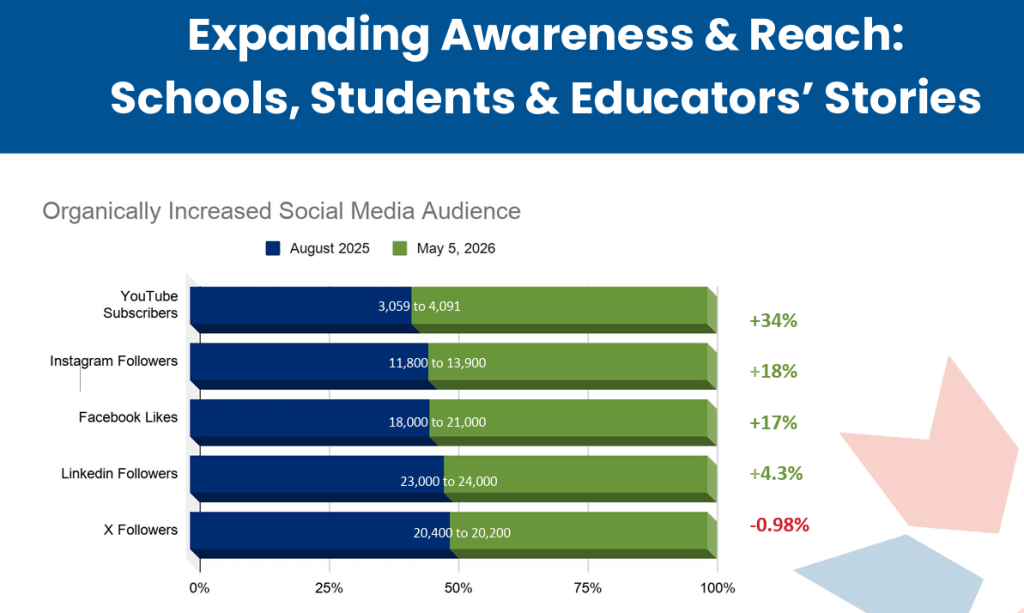
During Tuesday night’s board meeting, the district’s communications team gave trustees an update on the progress they’ve made toward improving communication with the public.
According to the presentation, they’re really knocking it out of the park. Staff said they’re reaching new people with district surveys and newsletters, engaging more community members and getting more schools featured in local media outlets.
But one element of the presentation caught my eye – a glaring, felony-level #chartcrime. From the oddly stacked bar chart to the meaningless percentages at the bottom, it’s a real doozy.
Do you have your own favorite chart (or graph) crimes from local school districts? Send ‘em my way.
The post The Learning Curve: He’s San Diego Unified’s Next Trustee – No Race Needed appeared first on Voice of San Diego.