Politics Report: The Second Home Tax Is Back
 EM - News Moderator


The tax is back.
A proposed ballot measure to tax second homes is coming back to the San Diego City Council Rules Committee this Wednesday.
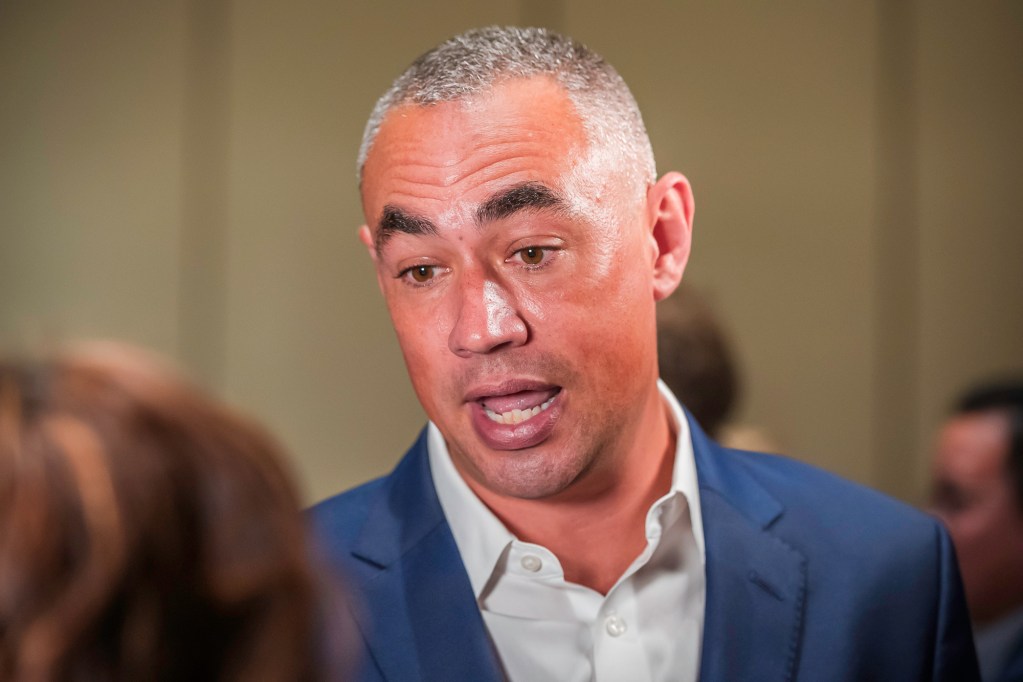
Councilmember Sean Elo-Rivera and his team took a loss on the first version of their proposal a few weeks ago. The initial plan was to tax empty second homes AND vacation rentals. Airbnb fought hard against it, and Elo-Rivera couldn’t carry it through committee. His frequent ally, Councilmember Kent Lee, voted against him, as did Raul Campillo and Vivian Moreno.
The vacation rental part of the plan seemed to be giving a lot of people heartburn. But based on the last hearing, it seems likely a second-home-only tax could pass.
Both Moreno and Lee said at the time they would support a tax on second homes. Lee called the idea a “clear progressive tax.”
“If someone can afford a second home and not use it for any other purpose including long- or short-term rentals, they can afford to pay that tax and should,” he said.
So how much will it be?
For the first year, $8,000 per home. The next year it would be $10,000 per home. And there would be additional surcharges for corporate-owned empty homes, starting at $4,000 in 2027.
Elo-Rivera’s office says this has the potential to bring in as much as $51 million. But here’s the really big question: Will there be easy workarounds?
Not necessarily.
One way people might seek to avoid the tax is by registering their empty second home as a vacation rental, but that is a limited option — and it’s also not free.
Vacation rentals are capped at one percent of the city’s housing stock — and several thousand licenses have already been issued. As of Wednesday, there were only 964 available short-term rental licenses left, according to a city webpage.
There are more than 5,000 empty second homes, according to Elo-Rivera’s office. We previously created a map of them, which you can find here.
Rich folks may already be starting to play musical chairs for those 964 licenses.
But even if someone successfully tried that workaround, they would still have to add to the city’s coffers. Vacation rental homes pay an annual license fee of $1,129.
There will likely be other workarounds, as yet undiscovered. For a home to be exempt from the tax, someone must live in it 183 days per year. According to the new proposal, that person could be a family member of the owner.
“We are working closely with the city attorney and office of the city treasurer on enforcement and implementation of the proposal,” Molly Weber, Elo-Rivera’s chief of staff, wrote in a text message.
Shocker: Richard Bailey Is Running for City Council, a Q&A
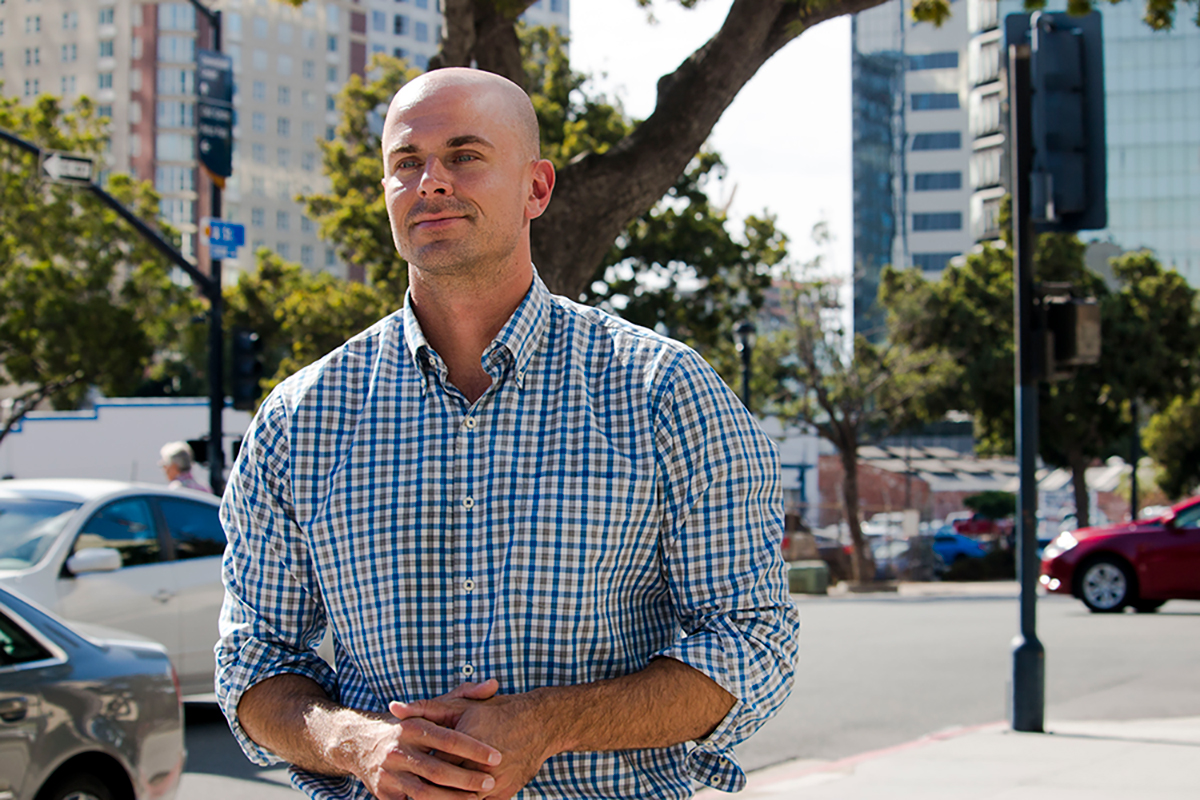
Former Coronado Mayor Richard Bailey moved to Point Loma a few months ago and is now running for City Council in San Diego.
This will be a big fun City Council race and we’ll be all over it but the Politics Report wanted to get some initial questions to him.
Politics Report: There are a few interesting questions that come up right away. Obviously, you just moved to the district. How do you plan on communicating to people about why you’re set up to represent them well?
Richard Bailey: “I would simply say it seems that there’s widespread opposition about what’s occurring at San Diego City Hall, and people are hungry for a change in leadership, and I think they look to cities like the city of Coronado, which has kind of been a model for good governance, and I think my experience gives me an advantage over the other candidates in terms of being able to deliver the change that voters want to see.”
Finances? That seems like what you want to really make your mark framing and talking about?
Richard Bailey: “Yeah, I think everything really starts and stops with the city’s budget situation. Between the budget situation and also the city’s desire to kind of bail themselves out of some poor financial decisions on the backs of everyday San Diegans through things like the parking fees at Balboa Park. To me this is just another example of bad governance, and it’s caused a lot of people to raise questions about the decisions City Hall is making. And so a combination of right sizing city hall and stopping the nickel and dime-ing of San Diego residents is where I think the voters want their leadership to be.”
Did you leave the Republican Party?
Richard Bailey: “I am a registered [no party preference], yes.”
When did that happen?
Richard Bailey: “I changed my registration yesterday (Feb. 19).”
Why?
Richard Bailey: “Oh, the thought process?”
Yeah.
Richard Bailey: “I think if you go back and like look through just about all of my public commentary, of all the videos, tweets, social media, posts I’ve made, over the years, not just recently, but like over my 12 years, four years on the City Council and eight years as mayor, you’re hard pressed to find many partisan comments that are… where I talk about red or blue, Republican or Democrat. I like policy, and I think that there’s this growing appetite amongst people across the political spectrum for just good policy, and leaving the politics off the table. I mean, we’re seeing that right now with a lot of voters, regardless of whether they registered as Democrats or Republicans.They’re just dissatisfied with the current state of the city. And they’re, they want someone that I think is a serious leader, that cares more about policy than politics.”
You don’t have any plans to become a Democrat, though?
Richard Bailey (laughs): “I do not have any plans to re-register with any political party. No.”
I think this is really interesting. You will have some success connecting with people about frustration with the city, maybe development plans, and ideas, infrastructure problems. Obviously, though, when they think about national politics, there’s this pretty significant antipathy toward Donald Trump and the movement that he’s led. Is that something you have supported and do not support anymore?
Richard Bailey: “I would simply say that, and this isn’t meant to be a dodge, this is just a, this is a local race. People care about local issues. It wasn’t the president that blew up the city of San Diego’s budget. It wasn’t the president who passed the trash fees, or the Balboa Park parking fees.It was the mayor of San Diego and the City Council. It always seems like the media wants to ask about thoughts on what the president is doing at the national level, even though San Diego voters are extremely dissatisfied with the direction the city of San Diego is going. And it seems that it would be more fair to ask the other candidates, well, ‘what are your thoughts on how Mayor Gloria is performing or how the City Council is performing on these issues that we’re actually campaigning to have some say in?’”
I sympathize with that. I think we both know that the biggest thing you’re going to have to overcome is whatever connection, however tenuous they might make it, between you and the president or you and the MAGA movement. I think people do see their leaders at, at every level of, as having to think about these things and represent them in that way that they might prefer on those issues. And there are local things. There’s the potential for more significant immigration raids, oil drilling off the coast, the border and tariffs and all kinds of stuff. Is there anything you could tell us about how you feel about those things and about how the president is leading things?
Richard Bailey: “All those issues you mentioned are outside the purview of local government, and they’re outside the purview of any of the nine councilmembers that will be sitting at the dais after November. So this campaign is just going to exclusively be about the local issues. I think I bring a lot to the table in terms of my knowledge and understanding of where the city’s budget is at right now, and my willingness to offer positions to solve the city’s structural deficit problem that won’t be popular inside City Hall but are certainly the right thing to do financially. And I think those are resonating with voters.”
You don’t want to say anything up or down, thumbs up or down on how Trump has performed as the president or on the big discussion nationally?
Richard Bailey: “I think that voters want to talk about San Diego.”
On the trash fee repeal, you had started a movement on that. Is that something you’re still pursuing?
Richard Bailey: “Yeah, very much so, and I think you’ll be seeing an announcement here very, very shortly, like in a couple days.”
Is there anything about the district in particular and things you want to focus on there that are going to be your priorities?
Richard Bailey: “All politics is local. There’s micro issues in every single neighborhood. Obviously, the Midway Rising proposal is going to be a big issue, and we’ll see how that shakes out and the courts. The OB Pier and finding a way to get some money to get that reopened and hopefully, sometime in our lifetime. But once again everything kind of starts and stops with the city’s overall financial condition.”
Do you support Midway Rising as it is proposed?
Richard Bailey: “I would say not as it is proposed, not as it is.”
What would you like to see differently?
Richard Bailey: “I think some changes need to be made. Right now, Rosecrans, as you and I know, it’s a total cluster. Whether you’re driving there at 5 a.m. or 5 p.m. and the idea that you can have that level of development without some other type of traffic mitigation, I think it’s asking a lot of a lot of Point Loma residents. I’d like to see some changes in the plan, as relates to, as relates to traffic, as relates to parking. I do think the Sports Arena site should be redeveloped. But I do have some issues with the process for which the Midway Rising project was awarded and we’ll see if there’s an opportunity to address that in the future.”
More Details About the Big County Overhaul
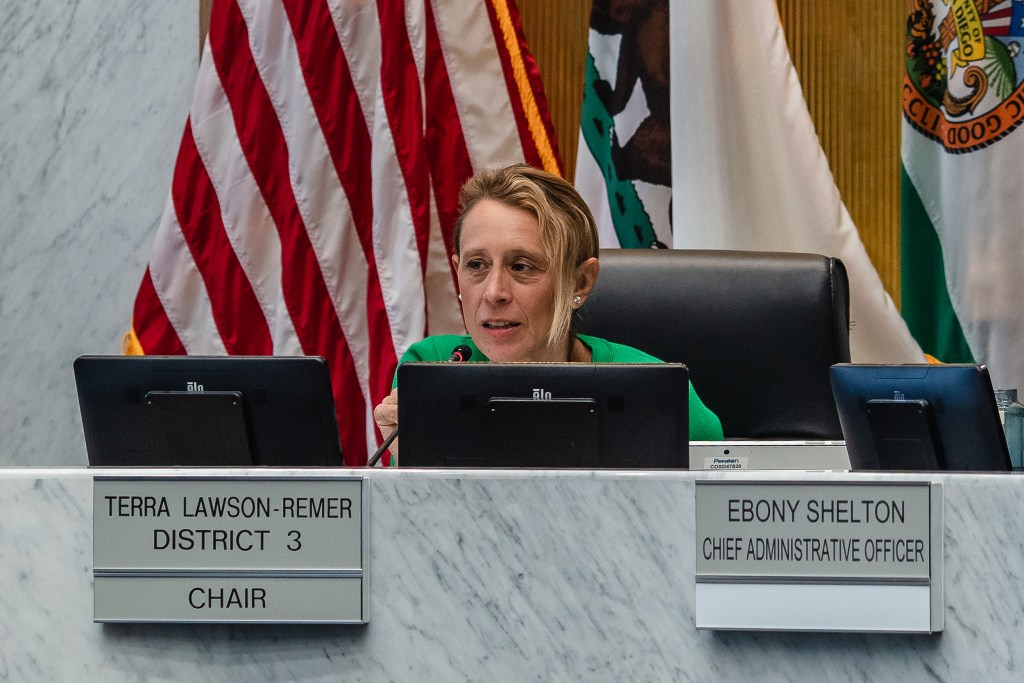
Dispatch from Lisa Halverstadt (who is killing it on the county beat): Two weeks ago, we broke the news on county Board Chair Terra Lawson-Remer’s push for major county government reforms including potentially extended term limits for supervisors including herself and converting the county’s top bureaucratic post into an elected one.
Lawson-Remer recently gave the Union-Tribune’s Lucas Robinson more details on the hoped-for November ballot measure to amend the county’s charter – and acknowledged the pitch for a county mayor has been the least popular proposal.
“Everything else — including, by the way, the term limits — has been a no-brainer,” Lawson-Remer told the U-T.
Lawson-Remer said she’s hoping for a board vote to kick off the process to place the measure on the ballot as soon as April. The deadline to do so is early August.
Among the other pitches, according to the U-T: a county ethics commission, independent budget and auditing offices likely similar to the city of San Diego’s Independent Budget Analyst’s Office and auditor who report to the City Council and direct power for supervisors to “confirm and remove top bureaucrats.”
Still under discussion: a possible elected county mayor, term limits for county elected officials who don’t now have them and a third term for supervisors including Lawson-Remer. The latter proposal comes just 15 years after labor groups and Democrats fought to create two four-year terms for supervisors to get more Democrats onto the board.
Questions on the county mayor pitch: The president of the county’s largest labor union, a key group that Lawson-Remer is likely courting, says her organization isn’t sold on the idea of an elected top county administrator.
“This proposed charter reform package has critical reforms such as strengthening independent ethics standards, audits and budget oversight. However, we are uncertain if the elected County Administrative Officer is right for our county as it could place too much power in the hands of one person,” Crystal Irving of SEIU Local 221 wrote in a statement.
Kyra Greene of the Center on Policy Initiatives, a group that has been partnering with Lawson-Remer as she explores charter changes, said Thursday she’s also not a fan of that change.
“It is one of the things I’m least interested in seeing happen,” Greene said. “I think it would be very disruptive, and I’m not convinced that it leads to better governance.”
BTW: The U-T confirmed Lawson-Remer’s office used $40,000 in taxpayer funds to survey about 700 residents on potential charter amendments last November.
We have requested records of this polling and an interview with Lawson-Remer. We’re waiting on both.
The Politics Report has a new co-writer. Will Huntsberry, now Voice’s assistant editor, will be helping each week. That should ensure that it’s more of a weekly rather than mostly weekly product. So if you have any ideas or feedback for the Politics Report, send them to scott.lewis@voiceofsandiego.org or will.huntsberry@voiceofsandiego.org.
The post Politics Report: The Second Home Tax Is Back appeared first on Voice of San Diego.