DoE: Diesel may hit P115 per liter
 EM - News Moderator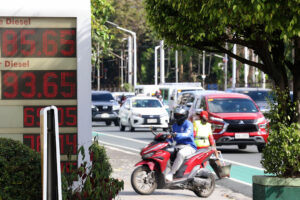


By Sheldeen Joy Talavera, Reporter
DIESEL PRICES could reach up to P115 per liter this week at gasoline stations within Metro Manila and nearby areas as a fresh wave of big-time price increases is set to be implemented amid the Middle East conflict.
Energy Secretary Sharon S. Garin confirmed that diesel costs could go beyond P100 per liter this week.
“It’s possible. Actually, our estimate is that it could reach P115,” she told reporters in a mix of Filipino and English.
Starting Tuesday, March 17, gasoline prices will increase by P12.90 to P16.60 per liter, diesel by P20.40 to P23.90 per liter, and kerosene by P6.90 to P8.90 per liter.
Based on the monitoring of the Department of Energy (DoE), gasoline prices may go as high as P91.60 per liter while diesel may surge to P114.90 per liter. Kerosene prices may jump to P143.79 per liter.
Some oil companies, including Shell Pilipinas Corp., Petron Corp., Total (Philippines) Corp., Seaoil Philippines, Inc., Flying V, and Jetti Petroleum, Inc., have agreed to stagger the implementation of the increase in two to three tranches within the week.
The latest price adjustments mark the 12th consecutive weekly increase for diesel and kerosene prices, and 10th straight week for gasoline.
“Today, we set a record. We have two of the highest jumps in oil prices. And (fuel prices) are also at the most expensive,” Ms. Garin said.
Local pump prices remain elevated amid the ongoing US-Israel war with Iran, which led to the closure of the Strait of Hormuz, a chokepoint for one-fifth of the world’s oil.
As a net importer of crude oil, the Philippines is vulnerable to global crude price swings.
Around 98% of the country’s crude imports are sourced from the Middle East. The remaining 2% is imported from Brunei and Malaysia.
ADEQUATE SUPPLY
Ms. Garin assured that the Philippines has enough supply that could last until end of April.
“The most important (thing) for today is that we have supply. There is no need to cause panic among our people,” she said.
Ms. Garin said that the government is negotiating for additional supply of fuel from other countries, including South Korea, Thailand, Singapore, and Japan.
The DoE has also tapped state-run Philippine National Oil Co. to search for alternative suppliers for stockpile.
Meanwhile, Ms. Garin said the country’s remaining oil refiner, Petron, is negotiating with Russia for supply of crude oil as the US eased sanctions on the latter.
“We’re waiting for that on what is the progress and talks on procuring from Russia, but we have already done the work,” she said.
Ms. Garin said she is in favor of revisiting the oil deregulation law, but to a certain extent.
“I do believe this system is only effective during good times. If prices are favorable for everyone, then things are fine. But in bad times, it does not work very effectively,” she said.
Enacted in 1998, the law allows oil companies to set and adjust pump prices based on global oil prices and other market factors, instead of awaiting government approval.
“In times like this, there has to be a certain control. Not because we want to limit profit or competition that is there, but we want also to protect the interest of the public,” Ms. Garin said.
The Energy chief also assured the country has a stable supply of electricity, but the consumption should be managed.
In a statement on Monday, consumer group ILAW Pilipinas urged the government to implement immediate measures that could help cushion consumers from price shocks, including the suspension or reduction of local taxes and tariffs on fuel and electricity.
“A potential increase in electricity prices shows how quickly international conflicts can translate into higher costs for households and small businesses,” said ILAW Pilipinas Youth Convenor Francine Pradez.