Barrio Logan raises its voice on César Chávez: Some call for not abruptly erasing his legacy
 Dante Ulanday - News Moderator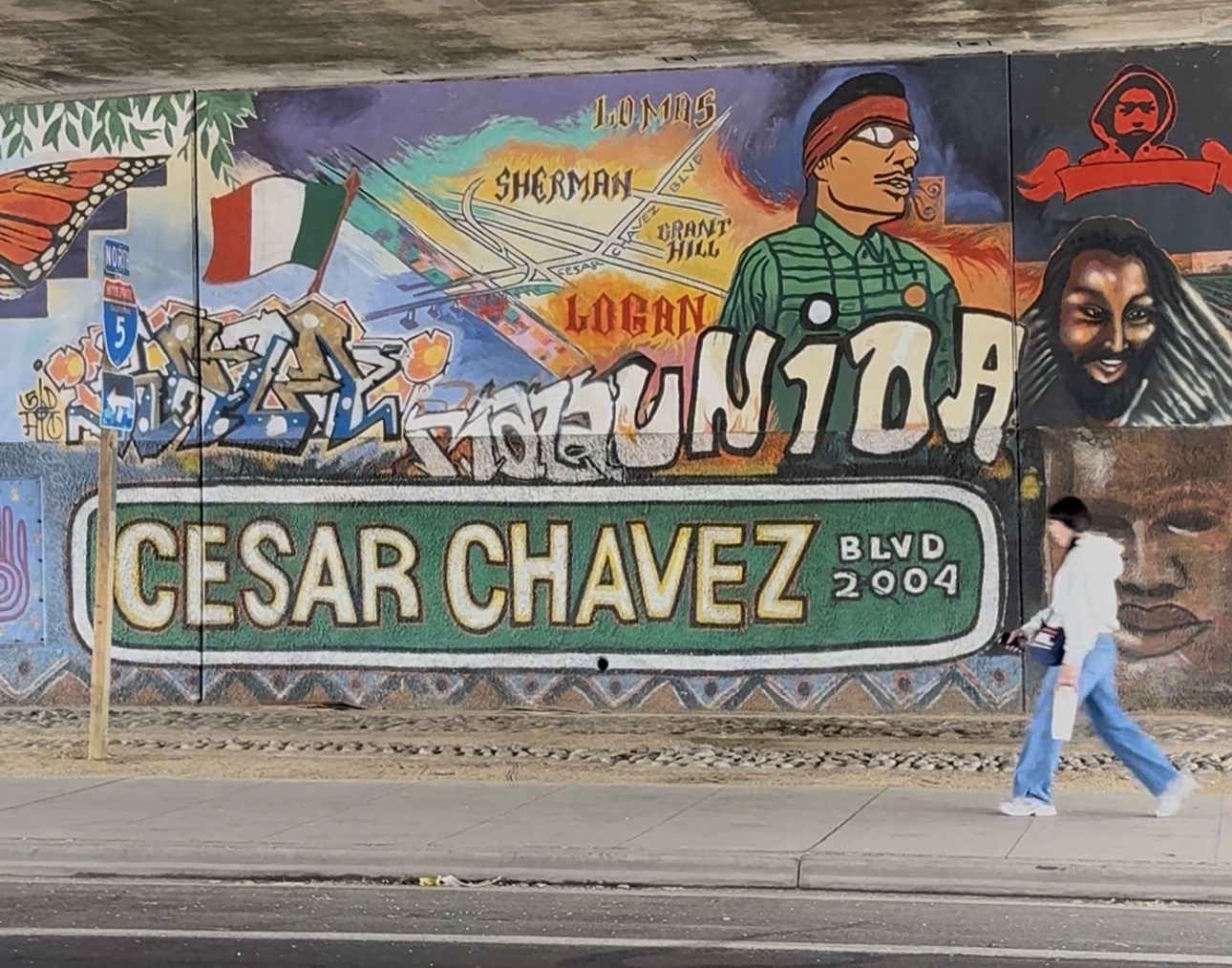



A woman walks in front of a mural celebrating César Chávez. (Photo by Carlos Aviles)
The march held in his honor was canceled. His name has already been removed from the signage of an elementary school in Southcrest.
And efforts to scrub César Chávez’s name from streets, parks, and other locations across the city of San Diego have gained momentum following an executive order by Mayor Todd Gloria.
However, for Juan Soto Castejón—a resident of Barrio Logan—public officials have acted too hastily, failing to take public opinion into account.
“It’s not fair. If they named streets and schools after him, it was because he earned it through so many years of struggle,” he said, sitting on the grass at the Southcrest Recreation Center. “And now comes a woman making all sorts of claims—why didn’t she do this while he was alive? Why is she doing it now, when he can no longer defend himself?” he added.
Chávez’s legacy has been tarnished by more than one accuser. The allegations, including sexual assaults on women and girls during the 1970s, and that he raped the co-founder of the United Farm Workers, Dolores Huerta—emerged from a New York Times investigation published earlier this month.
Across Southern California, some schools and universities reacted swiftly to the news, taking steps to effectively eradicate any trace of the farmworker leader from their campuses, websites and other materials.
In San Diego’s Barrio Logan, César Chávez’s presence is marked by his name on a park, on the neighborhood’s main thoroughfare, on murals and on an educational center.
However, on March 20, Mayor Gloria signed his order directing city departments to immediately begin removing any references to Chávez from city facilities programs, and other assets.
That has rubbed some locals the wrong way. For Matthew Besinger—a San Diego resident who was taking photos of the former César Chávez Elementary School—the decision was made with far too much haste.
“If we judged people by the bad things they did in their personal lives, we wouldn’t have any heroes,” he asserts. “It’s a complex issue … but I believe it is still important to consider what César [Chávez] did for workers. I don’t think we should erase him [from history],” he added.
Nohemí López Pérez, who was picking up her son from daycare in this predominantly Latino neighborhood, shares that sentiment.
“It’s really unfortunate, because for years now it has gone by that name; that is how the school is recognized, and changing the name feels like starting a whole new chapter,” she said, standing alongside her young son. “It would be better if they clarified [the accusations] before stripping the school of his name,” she added.
For his part, Emilio Salazar agrees with the authorities’ decisions, but expressed concern that Chávez’s name also might be removed from school curricula, thereby losing an important part of the history of Latinos in this country.
“Honestly, the movement itself is historic. If what they say he did is true, then fine (remove his name from buildings and monuments), but it will have a major impact on the history taught to children in schools,” he said. “It will significantly affect the message conveyed to children regarding our culture, their heritage and the suffering our people have endured here in California.”
Public school teachers in California have long taught about Chávez’s contributions to the labor movement. Now, in light of the recent accusations leveled against him, they are seeking ways to revise those lessons.
In a statement issued last week, the state’s Department of Education announced that it had compiled a list of resources to assist educators in shifting their focus away from Chávez to center on the farmworker movement in a broader context.
For Horacio Hernández, who was strolling with his daughter in César Chávez Park in Barrio Logan, the authorities should have waited and consulted with local residents before making these decisions.
“I would assume they conducted a study and reviewed the historical record when they originally named all these places after him,” he emphasized. “The accusations are serious, but I believe they should hold a public consultation rather than making decisions lightly.”
Regarding César Chávez Parkway in Barrio Logan, the city’s departments of transportation and development services have stated that they will reach out to residents and stakeholders and hold public meetings before presenting final recommendation to the San Diego City Council.
“They should do that with everything—the school, the park, everything. This must be a decision made by everyone, not just a few,” said Hernández.